Clubs bought the GPS. The injuries still arrived. What was missing?
Football can now measure almost every metre a player runs. That still does not reliably tell a club who will get injured. GPS measures load. It does not measure injury.
 Define
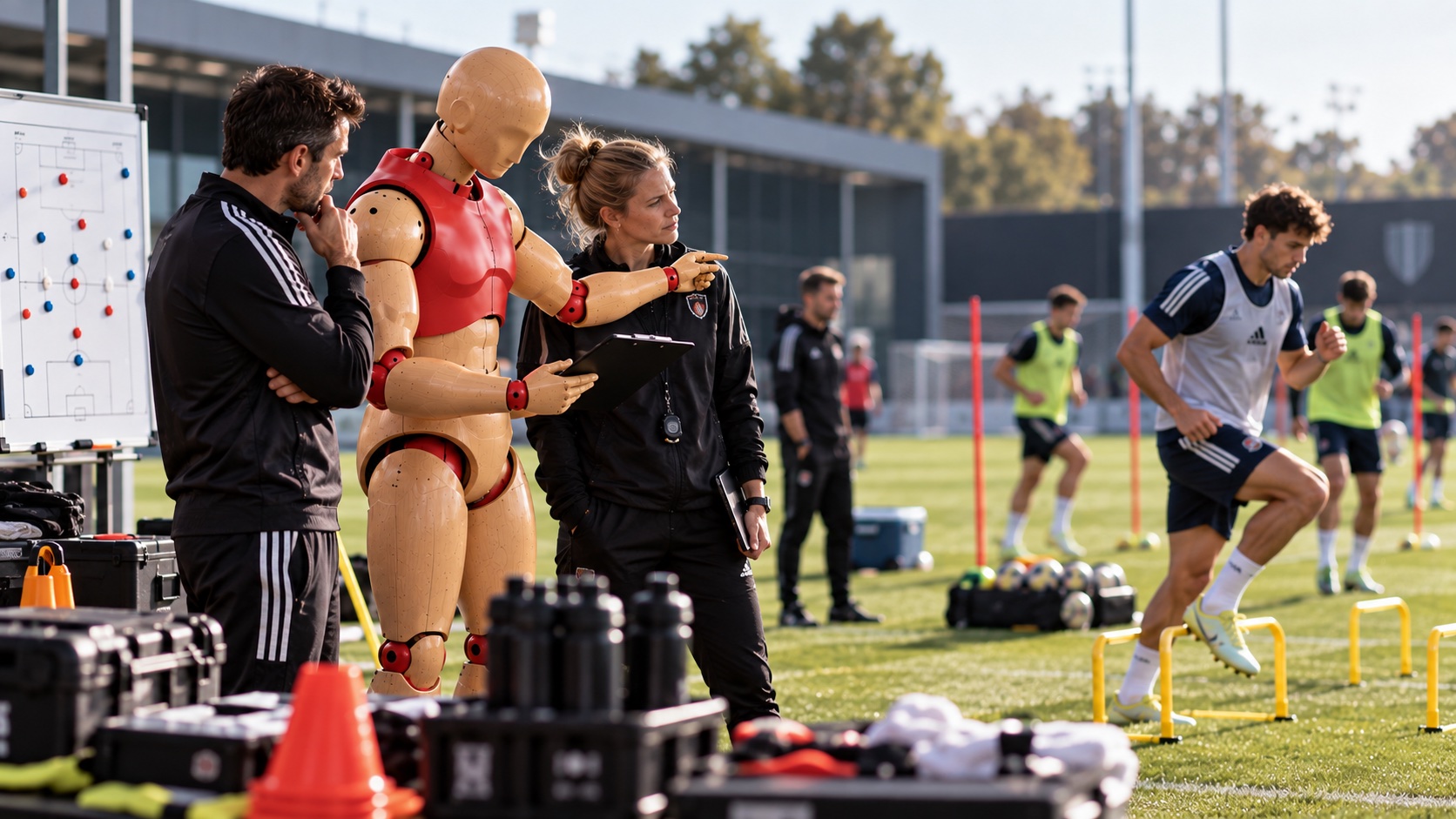
The vest was working. The hamstring still went.
A player pulls up in the seventieth minute with a soft-tissue injury. The GPS (global positioning system) vest was on all week. Distance, speed and high-speed running were recorded. Soft-tissue injuries still arrive.
Almost every professional club now funds that kit. Hundreds of session numbers sit on a coach screen.
The short answer is not that clubs simply forgot to hire interpreters. It is that GPS measures only part of an extremely complicated injury system.
A player week the dashboard only partly saw
Stay with one player week.
- Monday: recovery session. Low external load.
- Tuesday: normal training.
- Wednesday: a high-speed running spike relative to recent weeks.
- Thursday: the player reports feeling fine.
- Friday: GPS numbers look closer to normal again.
- Saturday: hamstring injury in the match.
What exactly should the club have known on Wednesday?
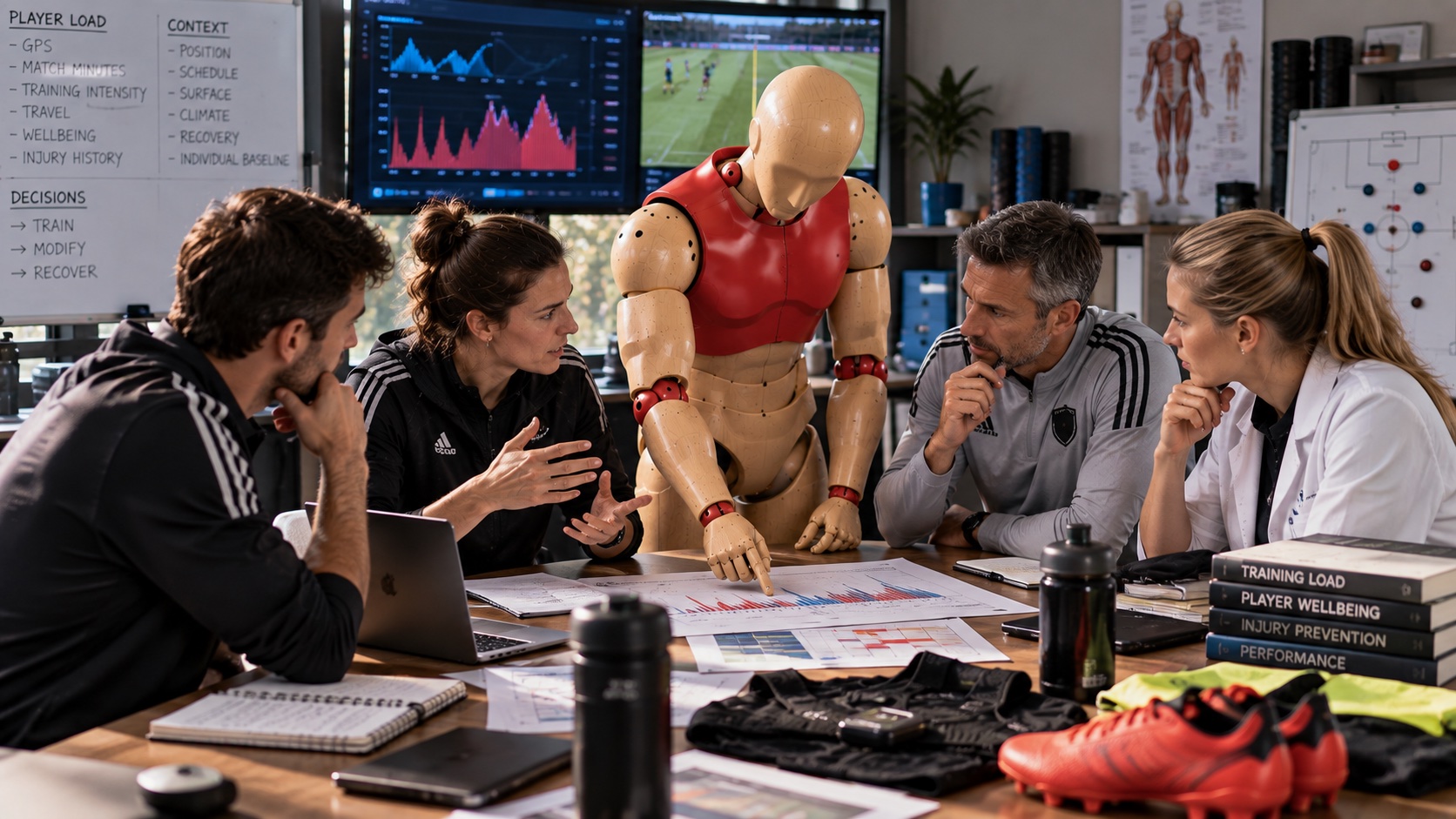
The vest knew distance, speed, accelerations, decelerations and sprint exposure. It did not directly know previous injury history, tissue capacity, strength, sleep, travel, fixture congestion, age, biomechanics, contact events, illness, or how recovered that player's muscle actually was. Some of those factors may matter a lot for this player. Some may not. Injury remains multicausal, and simple randomness still sits in the mix.
So the Wednesday spike could have been useful exposure that raised preparedness, an unusual load worth investigating further, or a number that would never have forecast Saturday. The dashboard cannot settle that alone.
 Define
GPS measures load. It does not measure injury.
GPS measures load. It does not measure injury.
A player can run 1,200 metres at high speed and the vest can record that with extraordinary detail. Will his hamstring fail on Saturday? That is a different question. The first is measurement. The second is prediction.
A 2026 Sport Mont paper on wearable external load and lower-limb muscle injuries in team sports, and a Frontiers multi-club look at workload ratios, both land on the same awkward finding: outside load alone is a weak predictor of soft-tissue trouble once you leave the lab. A Sensors methods paper shows why a screen can look precise while a forecast still is not. Precision in measurement is not precision in injury prediction.
That does not prove clubs systematically underfunded staff or shared definitions. It does show why a precise sensor does not automatically produce a precise injury forecast. A load red flag is a reason to look for context the vest cannot see, not a standalone injury forecast.
 Define
Three jobs: describe, monitor, predict
Those limits become clearer if you split three jobs.
- Describe: what workload occurred? Distance, high-speed running, sprints, accelerations.
- Monitor: is today's load unusual relative to this player's normal exposure?
- Predict: will this player suffer an injury?
A technology can be excellent at 1, useful at 2, and weak at 3. GPS often sits in that pattern. Success at describing and monitoring workload is not proof of success at forecasting soft-tissue injury.
That also kills the false binary that GPS either "works" or "does not work". It can work extremely well as a measurement system without being an injury crystal ball.
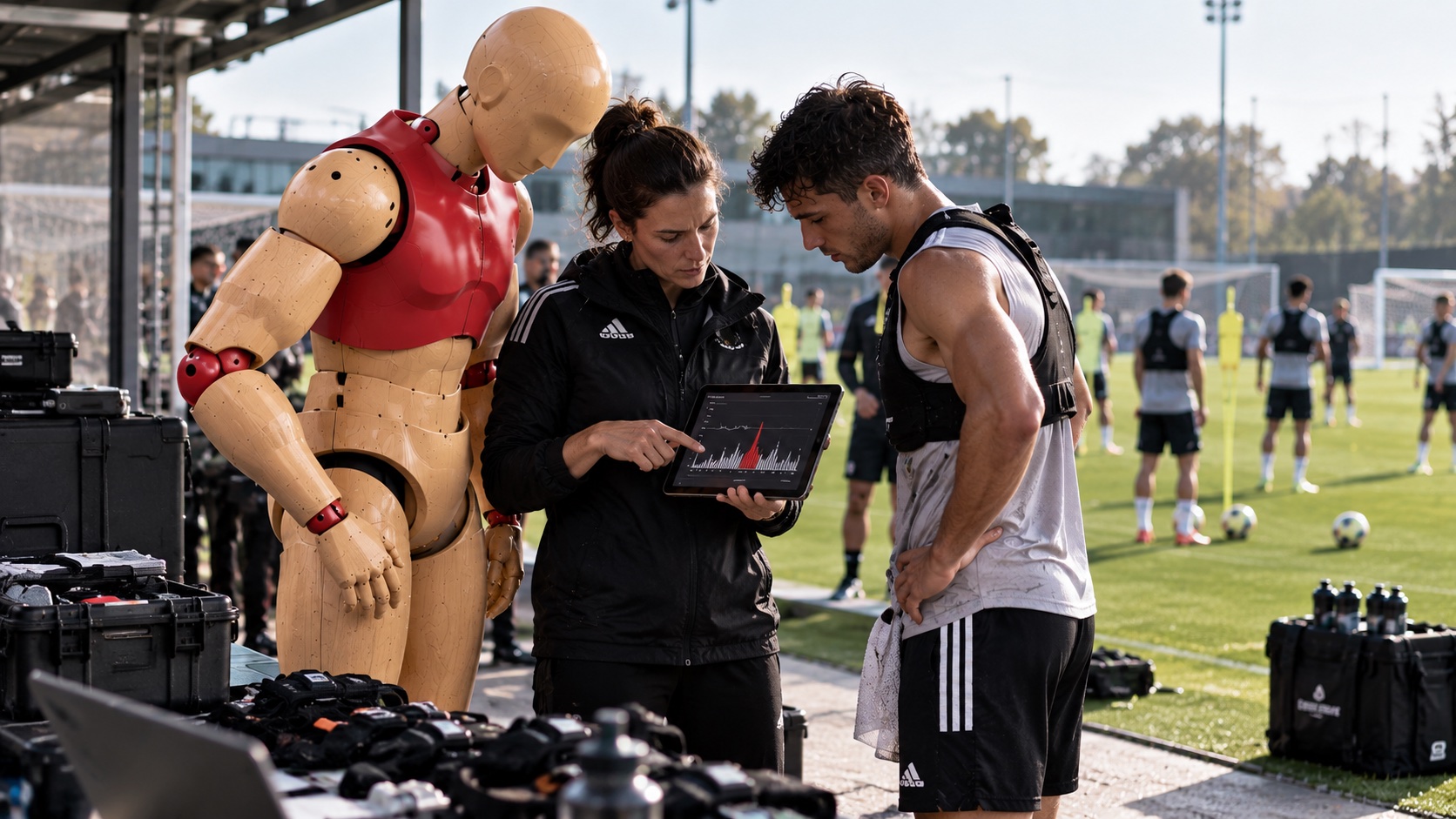
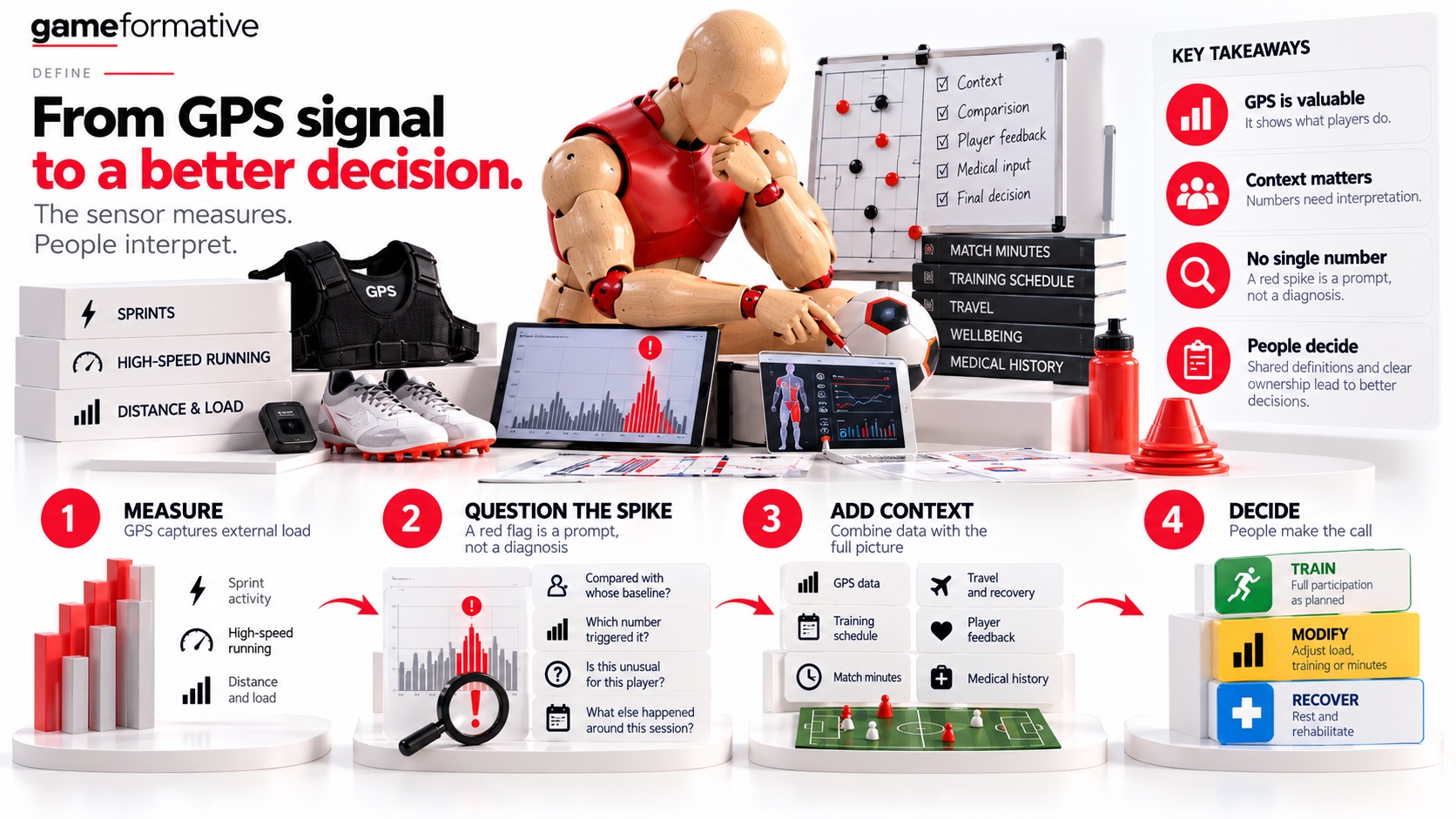
A red flag on high-speed or sprint load is a reason to look harder, not an automatic deload. Looking harder means bringing in information the vest cannot supply: previous injury, player-reported recovery, match minutes, medical assessment and the rest of the week's context.
Why simple risk scores struggle
Acute-to-chronic workload ratios became popular for an obvious reason. They promised to reduce a complicated injury problem to a single number: had recent load risen too quickly against the last few weeks?
Subsequent sports-science debate has challenged whether a universal "danger zone" can reliably predict injury, and has criticised treating the ratio itself as a prospective warning instrument. The idea remains attractive on a dashboard. The predictive claim needs much more caution than a tile labelled risk.
More broadly, simple risk scores struggle because injury is individual and multicausal. One external-load threshold cannot carry previous injury, recovery, strength, fixture congestion and chance at the same time. Adding any single extra variable also does not automatically produce reliable prediction. It only widens what the staff can see.
What GPS is actually good for
What GPS is actually good for is more modest, and more useful, than an injury alarm.
Clubs use it to understand exposure, plan training progression, compare sessions, manage high-speed and sprint loads across a congested calendar, and prompt further investigation when a player's external load looks unusual. Those are describe-and-monitor jobs. They matter even when standalone prediction stays weak.
Expect GPS to support decisions, not to replace them with a green or red prophecy. The vest answers what the player did. The medical and coaching staff still have to weigh what that means beside everything the vest cannot see.
Knowing what he did is not knowing what his body will do next
GPS solved an important problem in football. Clubs can now measure physical workload with extraordinary detail.
It did not solve the harder one. Knowing exactly what a player did is not the same as knowing what his body will do next.
Research record
Receipts for this article: sources, image provenance, and material we opened but did not rely on.
Mentioned entities
Products, brands, services and organisations named in this piece. Listed for clarity: this is not a sales offer. Try claims with a pinch of salt and compare other solutions.
- Sport Mont · organisation
- Frontiers in Public Health · organisation
- Sensors (MDPI) · organisation
Sources used
- Wearable-Monitored External Workload (GPS/GNSS/IMU) and Lower-Limb Muscle Injuries in Team Sports · Sport Mont · Primary team-sport workload vs soft-tissue injury framing
- Acute:chronic workload ratio and load management for team sports: a multi-club look · Frontiers in Public Health · Independent multi-club ACWR angle; not the same sample as Sport Mont
- Wearable sensor architecture for athlete external load (methods) · Sensors (MDPI) · Device/methods perspective: why precise sensors still need human load literacy
Image credits
- Headline: GPS injury risk on the pitch. GameFormative editorial desk. Licence: Original GameFormative editorial illustration (free to use with this article; © GameFormative 2026).
- Inline: load context in the performance lab. GameFormative editorial desk. Licence: Original GameFormative editorial illustration (free to use with this article; © GameFormative 2026).
- Inline: GPS spike shown to the player. GameFormative editorial desk. Licence: Original GameFormative editorial illustration (free to use with this article; © GameFormative 2026).
- Infographic: GPS signal to better decision. GameFormative editorial desk. Licence: Original GameFormative editorial illustration (free to use with this article; © GameFormative 2026).
Sources investigated but not used
- Reviewed but not used: insufficient evidence · ML approaches to wearable load (PMC / Sensors Basel) · PMC / Sensors (Basel)
- Reviewed but not used: insufficient evidence · AI injury risk in student-athletes · Discover Artificial Intelligence (Springer)