Cognition as a number: measure it, train it, or baseline it?
Clubs are buying brain tools for late-game chaos that GPS never fixed. Under one word on the invoice they often buy three different jobs: measure, train, or medical baseline. Here's how to tell them apart.
 Data
The vest is green. The decisions still fail.
It's the 88th minute.
The player's GPS (global positioning system) vest still looks fine. His physical load is inside the band the club watches every week. Yet he is reacting later. Passing options he saw in the first half are closing. In a loud stadium his feet seem a beat behind the ball.
Clubs spent a decade funding load numbers, nutrition and movement screens. Bodies got easier to count. Bad passes late in games, soft-tissue knocks that never showed on the load tile, and travel fog the morning after a flight did not disappear with them.
So desks started buying brain tools: short digital tests, 3D tracking drills, clinical batteries. The sales line is simple. The hard part is not.
Why clubs started buying brain tools
Physical metrics matured first. When late-game chaos still showed up beside green load tiles, clubs looked for a second kind of number.
What arrived on the market was sold under one broad label: cognitive. Measurement platforms, training drills and clinical batteries often sat in the same conversation, as if they were versions of the same product.
They are not.
A short browser test that maps attention and decision-making under pressure does a different job from a six-minute perceptual drill. Both differ again from a clinically validated battery used nearer medicine and research. Clubs that treat those as interchangeable buy the wrong answer for the question they actually have.
West Ham has already put one of these tools into Premier League work. Josh Ewens, the club's head of sport science and innovation, has talked about measuring the mental edge and tracking cognitive fitness across a season. That is observed use: a club running measurement beside physical programmes, not proof that every late miss is a cognitive problem.
 Data
Three different things sold under one word
Here is the useful split, said plainly.
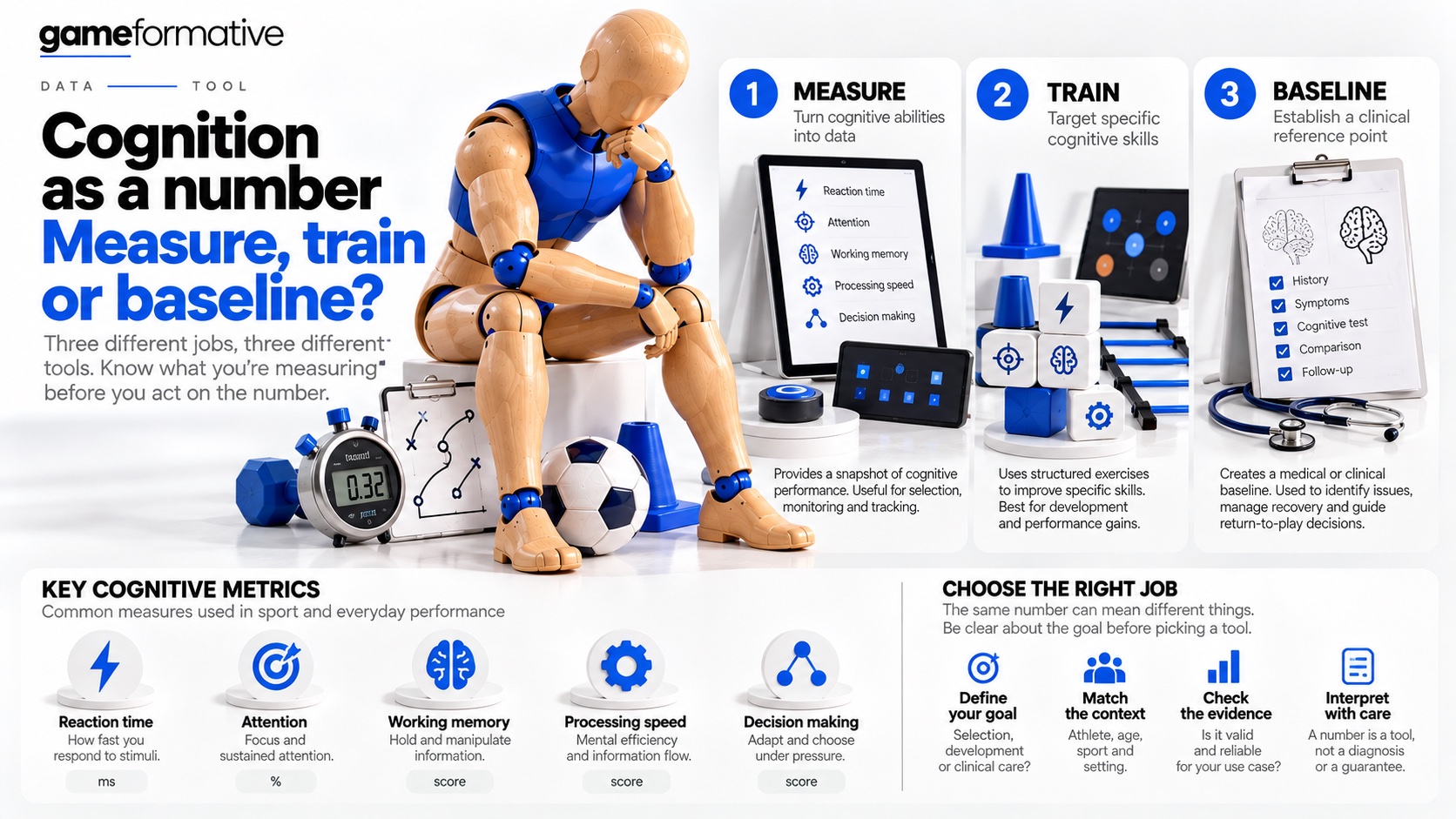
**Measure.** Tools such as CogMap run short browser tests, usually under 20 minutes. The player sits with a screen. The club receives a cognitive portrait: sustained attention, impulse control, memory agility, risk processing, decision-making under pressure. CogMap's own site is clear: the product is not built to train or improve ability. It measures and maps. In practice, that can tell a club where a player's cognitive strengths and weaknesses lie. It does not, by itself, renovate minute-88 choices.
**Train.** Tools such as NeuroTracker sell active drills. Their athletics brief describes 3D multiple-object tracking (MOT) sessions of about six minutes, aimed at attention, working memory, spatial awareness, processing speed and fatigue resistance. Here the club is trying to condition a skill, not only photograph it.
**Baseline.** Batteries such as Cambridge Cognition's CANTAB (Cambridge Neuropsychological Test Automated Battery) sit closer to medicine and drug trials: validated digital tests used at scale in brain-health research. That is nearer head-impact protocols and clinical notes than a pitchside readiness app.
Soma Technologies markets neurological training for progressive loading and response-inhibition style work; its public pages stay thin on named club rates. Senaptec sits in a similar sensory-training conversation. Thin public methods mean thin public claims.
The point is not a taxonomy for its own sake. Look for the job you actually need: identify talent, check daily readiness, condition on-field perception, or build a medical baseline. Choose the technology for that problem, not for the word on the invoice.
 Data
What that looks like at a Premier League club
At West Ham, CogMap has been used for Premier League cognitive benchmarking and athlete portraits. In practice that means a player completes a short digital assessment; the club gets a structured map of cognitive attributes; sport science can track that map across a season beside physical data.
Public case pages do not print outcome rates: how many late-game errors fell, or by how much. So the honest read is adoption and framing: a top-flight club is already treating cognitive measurement as real work next to GPS, not as a novelty slide. It is not a published proof that the tool fixed decision-making.
That Premier League example matters because it answers a reader question the taxonomy alone cannot: are serious clubs actually doing this? Yes, at least for measurement. The training and clinical lanes still need their own evidence, not borrowed glow from the same word on the invoice.
Can you train it, and should you trust the percentage?
NeuroTracker's athletics pages publish large percentage claims on reaction times and late-event mistakes. Those figures are vendor claims until the underlying papers are open on the desk, not only the marketing brief.
Social demo videos show a product in motion. They do not replace a primary help page, case page or clinical site.
Stories that blame every non-contact soft-tissue injury on cognitive fatigue still need a named study before they enter medical notes. Pattern-watching is fair. Writing cause from a sales demo is not.
And pitches that fold measurement, training and concussion baselines into one "brain operating system" collapse three different validation paths into a slogan. A portrait tool, a drill and a clinical battery do not share the same owner, the same protocol or the same standard of proof.
How a clinical baseline is a different job
Measurement vendors argue for an objective portrait free of scout bias, plus a weekly cognitive-fitness track beside load.
Training vendors argue for short drills that keep peripheral vision and decisions alive when the legs are tired.
Clinical vendors argue for validated baselines and subtle change detection, especially around head impacts and research protocols.
Coaches who already fund GPS hear another worry: another dashboard without a named owner, and another chance to misread a green physical score as a finished readiness call.
Those are different fights. Treat them as one product and a club can end up with a training drill when it needed a medical baseline, or a portrait tool when it needed a drill.
If you're evaluating these tools
If you're evaluating these tools, keep four questions on one page:
- What problem are we trying to solve: talent, readiness, conditioning, or medical baseline?
- What does the player actually do, and how long does it take?
- Who owns the result (sport science, medical, or recruitment), and what decision could change because of it?
- Which claims are established evidence, observed club use, or vendor marketing?
Established evidence and observed use (a Premier League club running cognitive portraits) are not the same as a vendor percentage. And none of those automatically prove that a coach should change tactical load when cognitive scores dip while legs still look fine. That is a possible application worth debating, not a demonstrated protocol.
Research record
Receipts for this article: sources, image provenance, and material we opened but did not rely on.
Mentioned entities
Products, brands, services and organisations named in this piece. Listed for clarity: this is not a sales offer. Try claims with a pinch of salt and compare other solutions.
- CogMap · product
- NeuroTracker · product
- Cambridge Cognition · brand
- CANTAB · product
- Soma Technologies · brand
- Senaptec · brand
- West Ham United · organisation
- Premier League · organisation
Sources used
- CogMap platform (ecosystem, West Ham sport use, Josh Ewens) · CogMap · OPENED (verbatim): measurement products (Edge/Well/Fit), under-20-minute assessments, West Ham sport card, Ewens on measuring mental edge / cognitive fitness.
- CogMap FAQ: measurement not training · CogMap · OPENED (verbatim): not designed to train or improve ability; cognitive portrait; attributes listed; 12–20 minute assessments.
- CogMap case studies (West Ham / MSA sport) · CogMap · OPENED (verbatim): West Ham cognitive benchmarking / portraits in Premier League; MSA academy talent spotting.
- NeuroTracker athletics use case · NeuroTracker · OPENED (verbatim): 3D MOT training claims, ~6-minute sessions, attention/working memory/spatial/focus/fatigue; marketing % claims noted as vendor claims.
- Cambridge Cognition homepage · Cambridge Cognition · OPENED (verbatim): brain health measurable at scale; CANTAB heritage; research/clinical framing, not a club readiness app.
Image credits
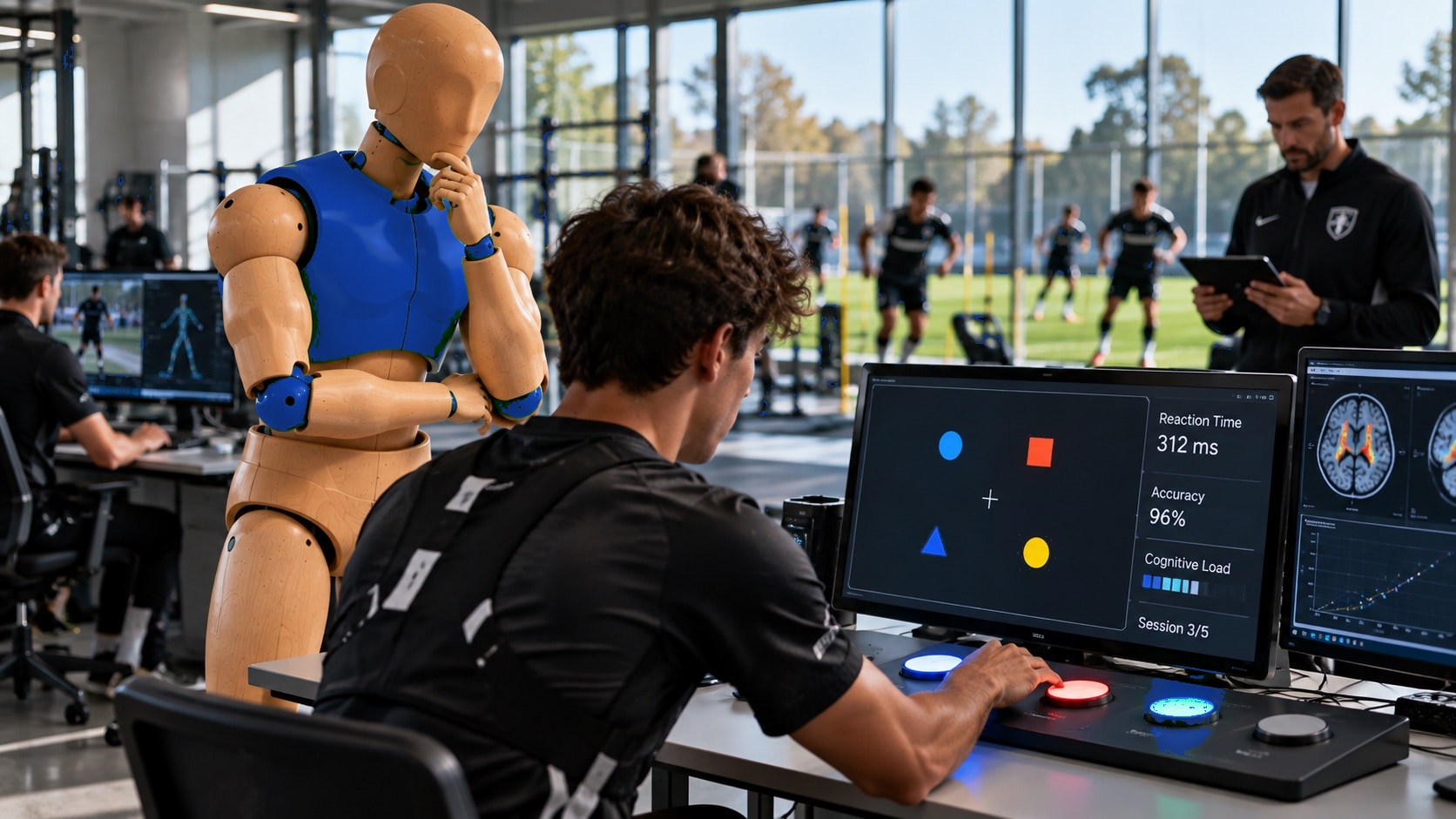
- Headline: cognitive reaction bay. GameFormative editorial desk. Licence: Original GameFormative editorial illustration (free to use with this article; © GameFormative 2026).
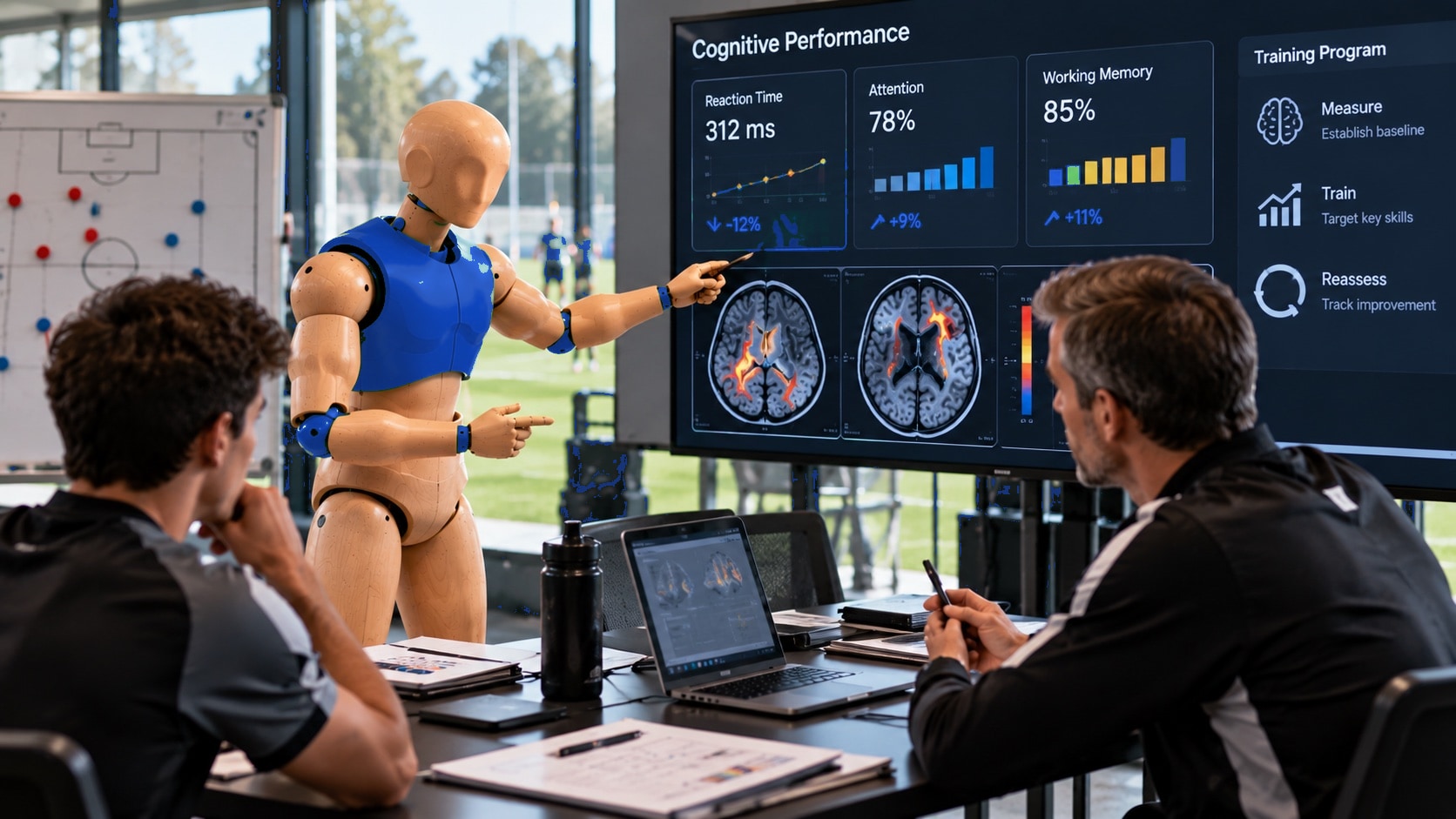
- Inline: cognitive performance review. GameFormative editorial desk. Licence: Original GameFormative editorial illustration (free to use with this article; © GameFormative 2026).
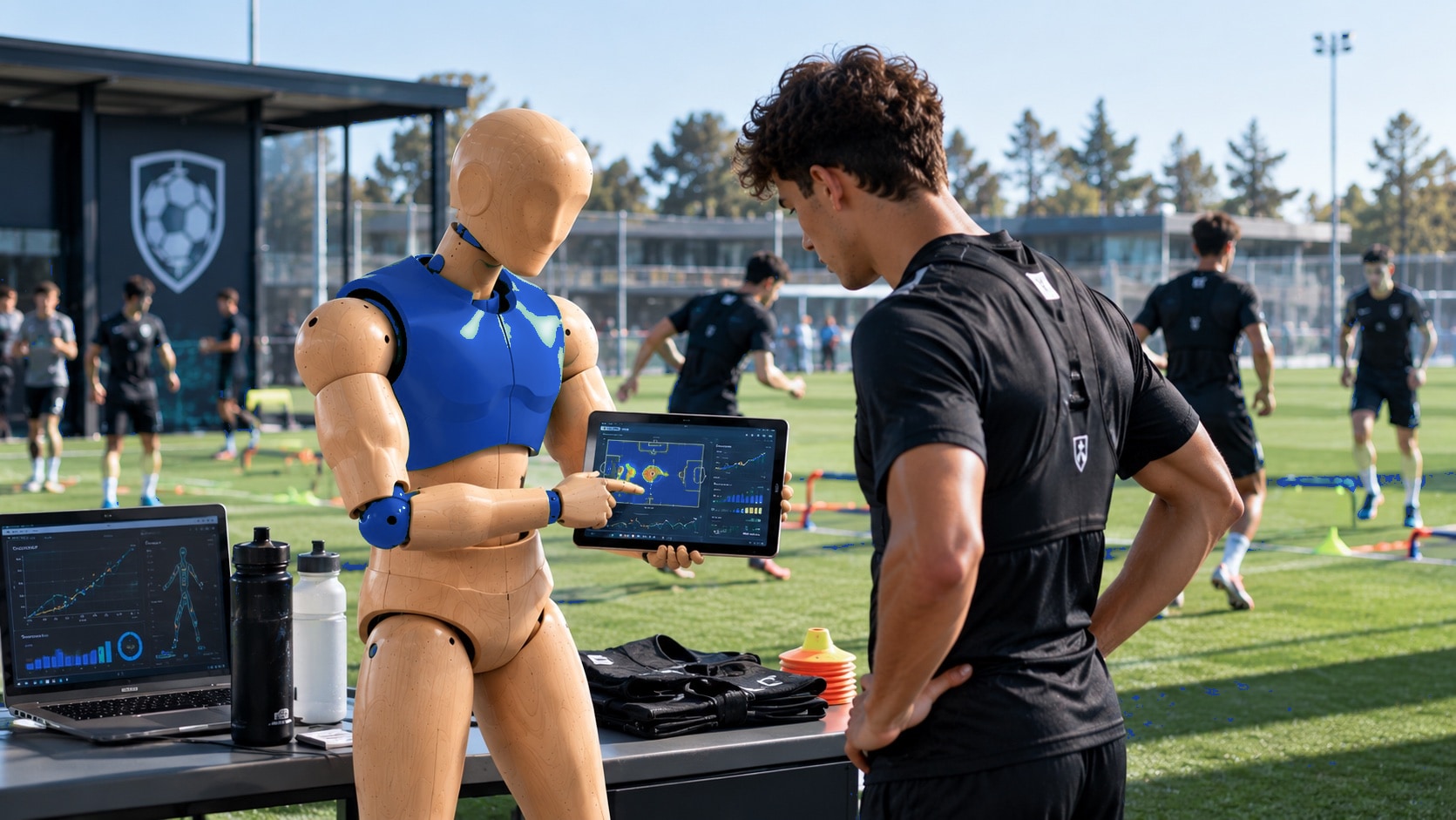
- Inline: pitchside cognitive tablet. GameFormative editorial desk. Licence: Original GameFormative editorial illustration (free to use with this article; © GameFormative 2026).
- Infographic: Cognition as a number. GameFormative editorial desk. Licence: Original GameFormative editorial illustration (free to use with this article; © GameFormative 2026).
Sources investigated but not used
- Reviewed but not used · CogMap /case-study deep page · CogMap
- Reviewed but not used · Soma NPT homepage · Soma Technologies
- Reviewed but not used · Senaptec official site · Senaptec
- Reviewed but not used · NeuroTracker Facebook demo video · Facebook
- Reviewed but not used · Soma Technologies Facebook session video · Facebook
- Reviewed but not used · Virginia Tech Works bitstream download · Virginia Tech