560 pings a second. Why football's smart ball changes what video referees can see.
 Discover
Why this matters now
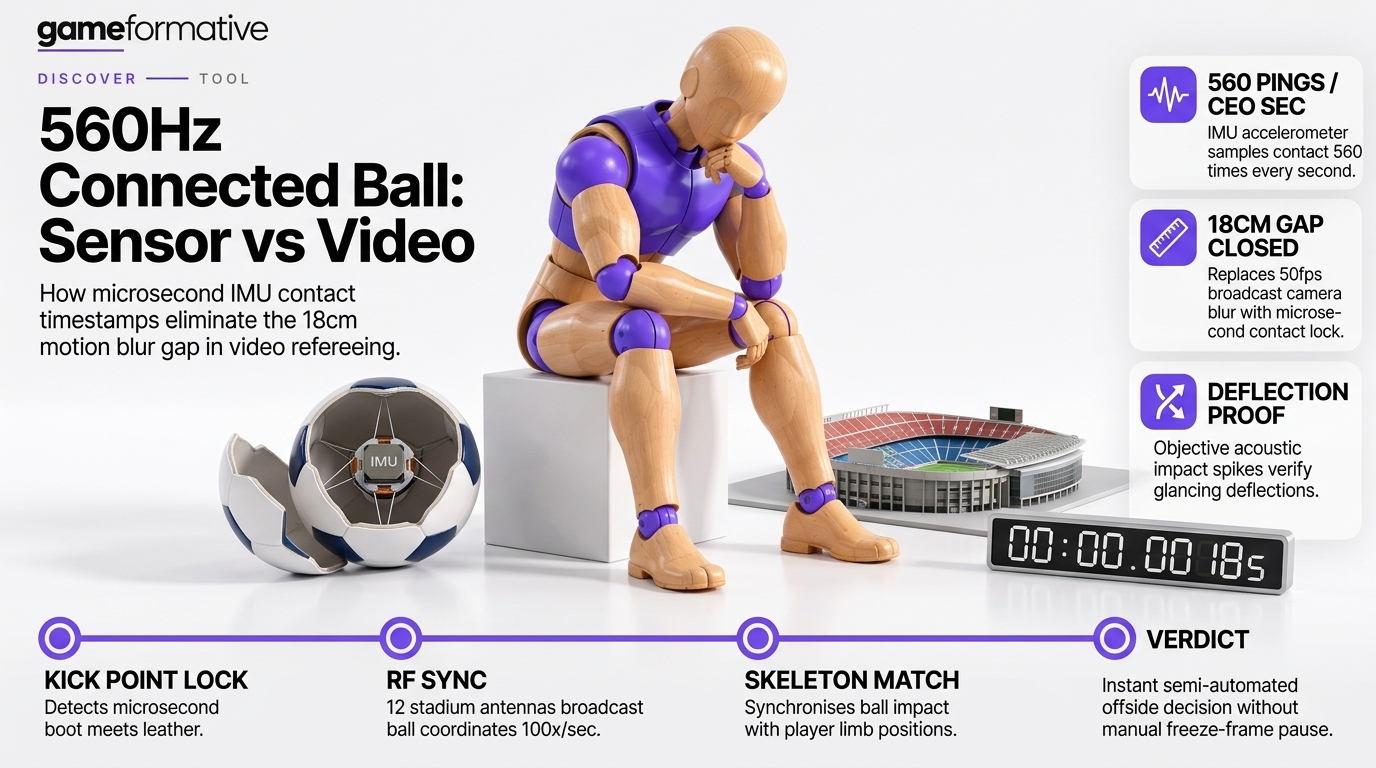
Imagine sprinting at full speed past a defensive line while a broadcast camera twenty metres away tries to take your picture. At thirty-two kilometres an hour, a striker travels eighteen centimetres between two single frames of standard fifty-frame-per-second video.
If a human video assistant referee clicks pause one frame early, an attacker looks comfortably onside. If they click pause one frame late, that same attacker is half a boot offside.
That gap is why La Liga became the first major domestic league to put a connected microchip inside every match ball for the 2026/27 campaign. The technology promises to replace video freeze-frame guesswork with a calibrated electronic heartbeat.
The landscape
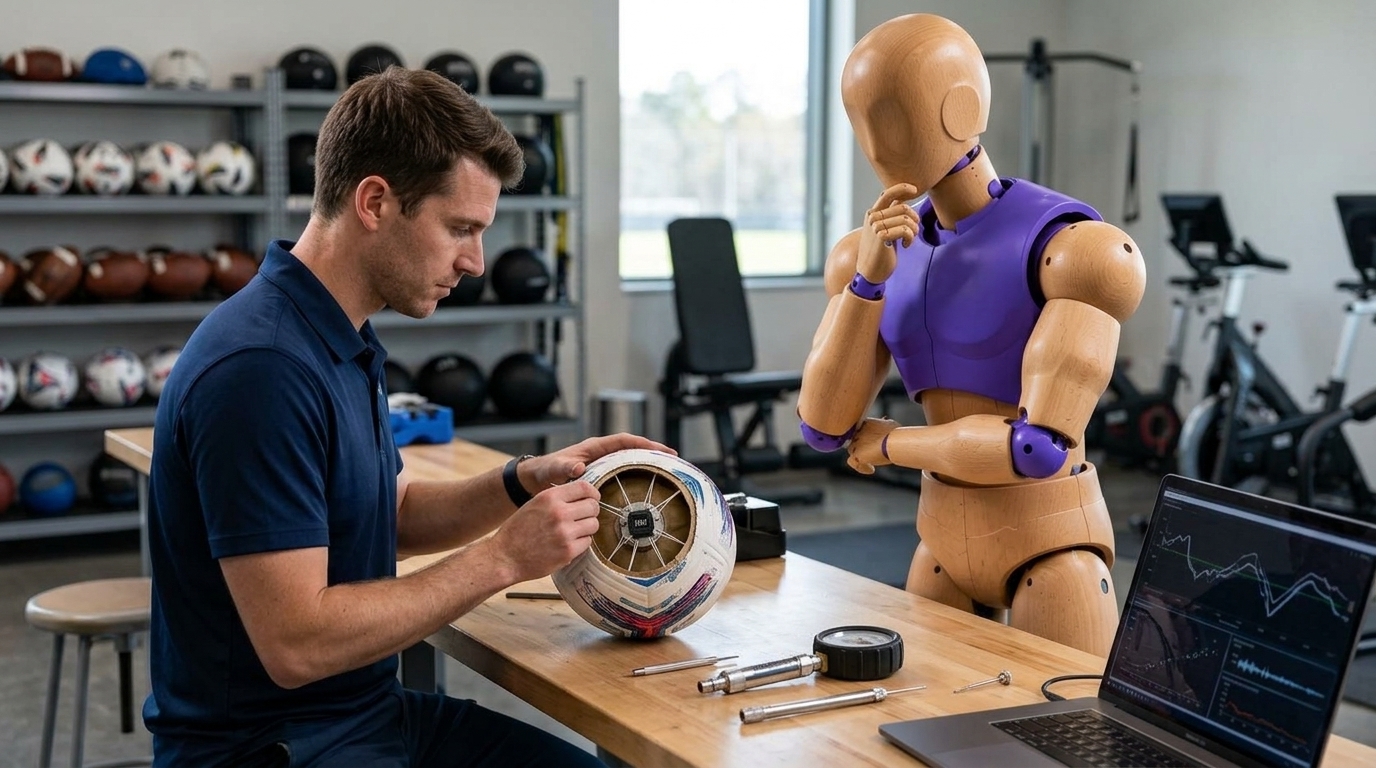
At the center of the new match ball sits a fifteen-gram inertial measurement unit suspended inside the bladder by eight elastic cords. The sensor houses an accelerometer and a gyroscope sampling at five hundred and sixty signals per second.
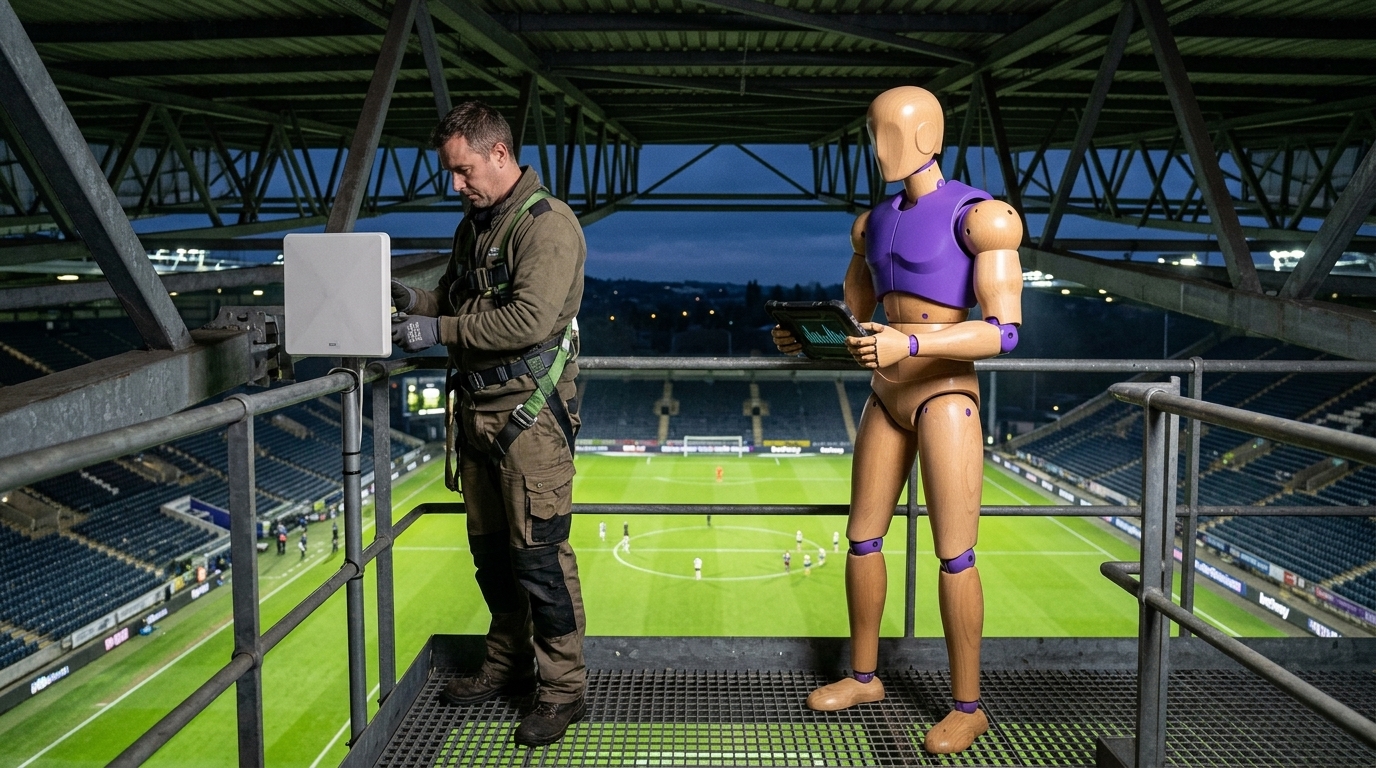
Twelve ultra-wideband receiver antennas mounted around the stadium roof structure capture those transmissions in real time. They record the ball's precise spatial coordinates one hundred times per second while tracking contact impacts down to 1.8 milliseconds.
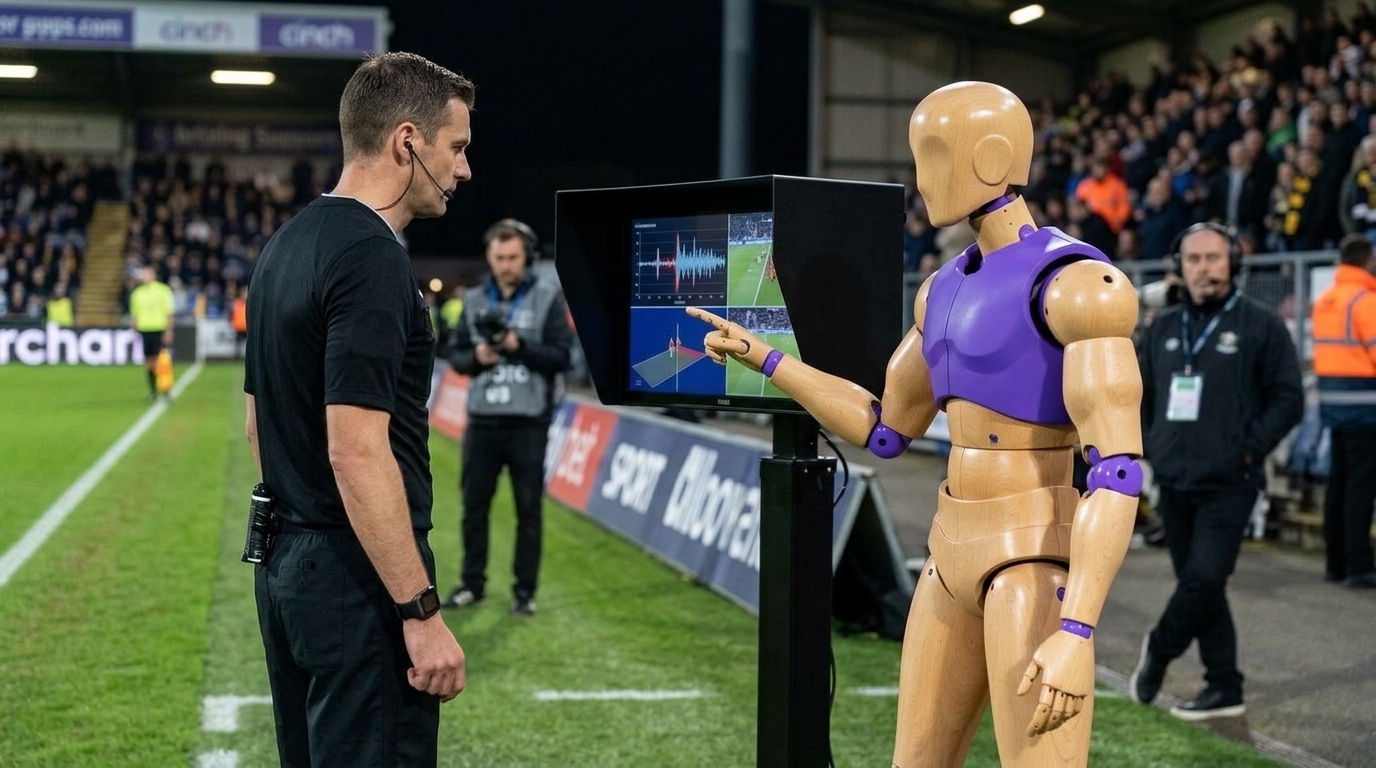
When a midfielder strikes a pass, the sensor detects the sharp acceleration spike of boot meeting leather. That timestamp synchronises automatically with optical skeletal tracking cameras around the ground.
The same sensor stream powers automated deflection detection, double-touch verification on penalty kicks, and rapid review of goal-line scrambles.
 Discover
What you can do with this
Who this is for: technical directors, competition managers, and match officials who evaluate how automated officiating actually interacts with matchday flow.
Before you evaluate whether sensor balls solve officiating friction, split what the technology can and cannot measure:
- Look for kick-point synchronisation: the primary value is eliminating the eighteen-centimetre motion blur gap in offside lines.
- Test deflection verification: the accelerometer spike distinguishes between a deliberate pass and an accidental glancing touch.
- Start with calibration checks: stadium receiver arrays require precise spatial mapping to maintain centimetre-level accuracy across ninety minutes.
 Discover
What we would keep
Keep the physical engineering achievement. Suspending an active electronic sensor inside an inflated competition ball without altering flight trajectory, bounce elasticity, or feel is genuinely difficult. Professional players tested the prototype across thousands of practice kicks without detecting the fifteen-gram core.
Keep the speed of decision support. Feeding an objective impact timestamp straight into semi-automated offside software trims thirty to forty seconds off routine offside reviews.
Keep the transparency on deflections. In penalty-box scrambles where four legs swing simultaneously, an acoustic accelerometer signature provides objective data that television angles often obscure.
What we would question
Question any marketing claim that connected balls eliminate controversy from football. Precision in measuring contact is not precision in interpreting intent.
A sensor can tell you that leather touched a defender's wrist at 42.18 seconds past the minute. It cannot tell you whether the arm was in an unnatural silhouette or whether the movement was deliberate.
Question whether fractional offsides improve the sport for supporters. Knowing that an attacker's shoulder was three millimetres ahead of a defender because an internal chip fired five hundred times a second provides mathematical certainty. It does not provide intuitive satisfaction to fans celebrating in the stands.
How the field is arguing it
Coaches and analysts are already adapting tactical preparation to the technology. High defensive lines that relied on split-second offside traps now face automated millimeter verification rather than human assistant referee reaction delay.
In the Premier League and other competitions still evaluating full ball-sensor integration, critics point to hardware cost and replacement logistics. Match balls that fly into the crowd or suffer puncture damage require battery charging docks and constant radio pairing on the touchline.
Referees describe the sensor feed as a relief for objective line calls, but caution that it raises fan expectations for subjective decisions where technology provides no verdict.
Closing note
Putting a five-hundred-hertz sensor inside a football solves the hardest technical problem in video officiating: knowing the exact microsecond of impact.
It leaves the hardest human problem untouched: deciding what that impact actually means.
Research record
Receipts for this article: sources, image provenance, and material we opened but did not rely on.
Mentioned entities
Products, brands, services and organisations named in this piece. Listed for clarity: this is not a sales offer. Try claims with a pinch of salt and compare other solutions.
- LALIGA · organisation
- Puma · brand
- Puma STELLAR NITRO · product
- Kinexon · organisation
- FIFA · organisation
- Premier League · organisation
Sources used
- La Liga and Puma introduce Connected Ball Technology across all 2026/27 matches · La Liga · Official announcement of the 2026/27 rollout of Puma STELLAR NITRO ball with Kinexon IMU sensor
- Kinexon Football Sensor Data Architecture and 560Hz Real-Time Transmission · Kinexon Sports · Technical specifications: 15g central sensor, 560Hz transmission rate, 12 ultra-wideband stadium antennas
- FIFA Semi-Automated Offside Technology (SAOT) Implementation Framework · FIFA · Integration protocol between optical tracking systems and IMU impact timestamps
Image credits
- Headline: connected ball IMU sensor core inspection. GameFormative editorial desk. Licence: Original GameFormative editorial illustration (free to use with this article; © GameFormative 2026).
- Inline: stadium antenna array and 560Hz signal tracking. GameFormative editorial desk. Licence: Original GameFormative editorial illustration (free to use with this article; © GameFormative 2026).
- Inline: pitchside VAR review and impact timestamp. GameFormative editorial desk. Licence: Original GameFormative editorial illustration (free to use with this article; © GameFormative 2026).
- Infographic: 560Hz Connected Ball: Sensor vs Video. GameFormative editorial desk. Licence: Original GameFormative editorial illustration (free to use with this article; © GameFormative 2026).
Sources investigated but not used
- Reviewed but not used · Cymru Premier VAR Light pilot approval and trial scope · FAW
- Reviewed but not used · Genius Sports Brazilian Serie A optical tracking agreement · Business Wire
- Reviewed but not used: duplicate evidence · Adidas Trionda 2026 World Cup Match Ball Retrospective · Forbes SportsMoney