When women crash in pro cycling, the damage looks different
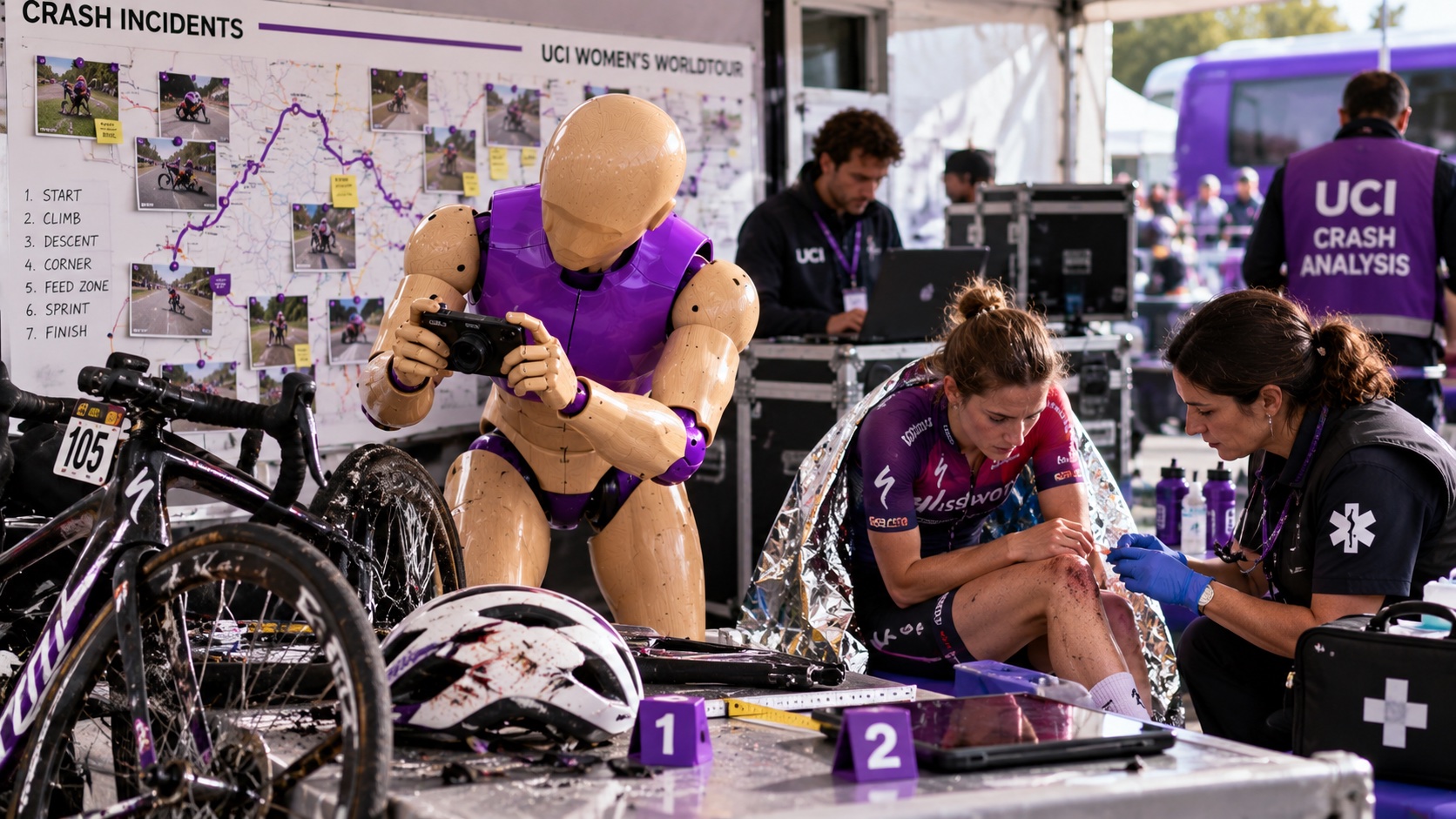
The UCI's first sex-disaggregated crash census found bigger pile-ups, higher injury rates and roughly twice the time away from racing for women. The numbers are preliminary, and researchers still don't know why.
 Discover
Cycling finally measured a gap it could only argue about before
Professional cycling has spent years debating whether women face different crash and injury risks from men. The problem was surprisingly basic: there was not enough comparable data split by sex.
In March 2026 the Union Cycliste Internationale (UCI), world cycling's governing body, started collecting it at WorldTour and Women's WorldTour races. The first results are uncomfortable.
The first look, in plain numbers
UCI's first look (congress presentation figures reported by Cyclingnews, 24 September 2026):
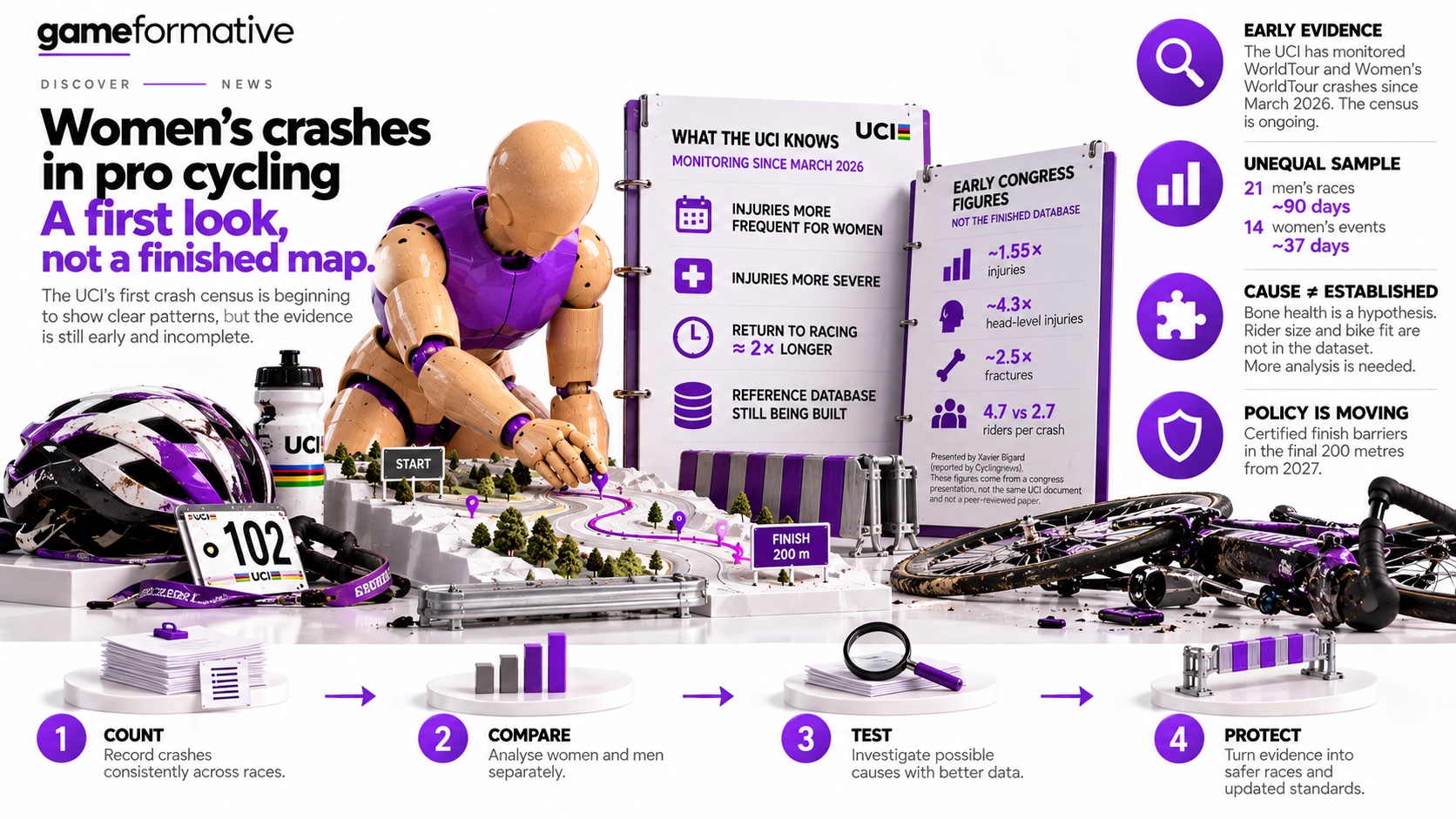
- Riders involved per crash: women about 4.7 / men about 2.7
- Injury rate: about 1.55× higher for women
- Head-level injuries: about 4.3× higher
- Concussions: about 2.3× higher
- Fractures: about 2.5× higher
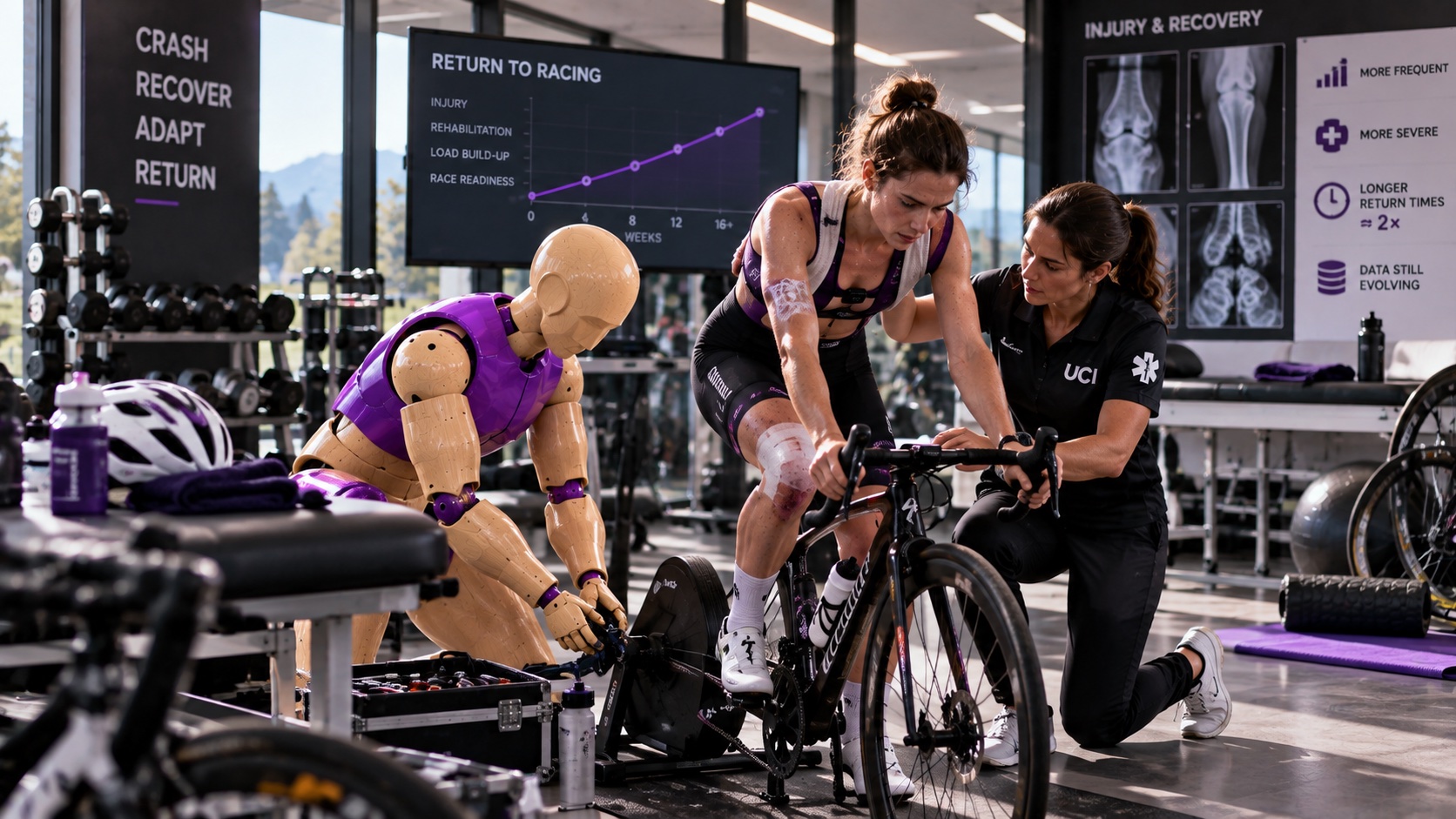
- Return to competition: about twice as long
The UCI's own Montréal release a day earlier stays in plain language: injuries more frequent and more severe among female riders, return times roughly double, study ongoing, reference database under construction.
Preliminary data. Women's sample smaller (14 women's events across about 37 days against 21 men's races across about 90 days). Figures from a congress presentation, not yet a finished peer-reviewed study.
The numbers do not need dramatic language. They are already dramatic.
 Discover
Why? The honest answer is: we don't know yet
Why are women's outcomes different?
The honest answer right now is: we don't know yet. What that means for teams and federations is that the gap is measurable before the mechanism is.
The available dataset does not yet include rider height, weight or frame geometry. Bone health has been raised by Medical Director Xavier Bigard as a clear hypothesis, not an established explanation. Descending crashes were the most severe for both sexes. No contributing factor was identified for women in the presentation as reported.
Plausible research questions remain open: bike geometry and fit, peloton dynamics, course design, physiological differences in injury severity, racing experience and professionalisation, medical reporting differences, or several of those interacting. Those are questions. They are not conclusions.
 Discover
What twice as long away from racing actually costs
Return to competition taking roughly twice as long is not only a medical line on a slide.
For a professional rider, the extra weeks can mean missing a stage race, losing race rhythm, missing selection, interrupting ranking opportunities, putting pressure on a contract conversation, or forcing a season plan to be rebuilt around rehab. Three weeks and six weeks are different careers in a short calendar.
That is what the return-time gap costs in sporting life. The census does not name individual riders. It still describes a pattern that reshapes seasons.
Safety rules are already changing beside the unfinished science
The census arrives while professional cycling is already changing its safety rules. That is context, not a proven causal chain from these sex-split figures to each new measure.
From 2027, WorldTour and Women's WorldTour finishes must use certified barriers in the final 200 metres, standards drawn from an independent Swiss engineering study cited in the UCI release. GPS (global positioning system) safety tracking is set to expand under a regulatory framework the federation says it will develop as quickly as possible, after championship trials.
Barrier kit and a tracking rulebook change finish design and location. They leave bone health, bike fit and peloton dynamics still unresolved. What changes on the road next season is protection hardware and tracking. What does not change automatically is the explanation for the women's crash pattern.
The pattern is clear enough to investigate. Its cause is not.
The signal is concerning enough to investigate and to keep tightening race safety. The evidence is not mature enough to explain why the gap exists. Both can be true at once. That is normal science, not a debate that needs invented camps.
The census began in March and covers WorldTour and Women's WorldTour racing. The first analysis is uneven, particularly on the women's side, but it gives cycling something it previously lacked: a live federation dataset comparing crash outcomes by sex. Earlier peer-reviewed injury reviews had already flagged how scarce that split was.
The pattern is clear enough to investigate. Its cause is not.
A measured gap without a measured reason
For the first time, cycling has numbers showing that crashes appear to affect its women's peloton differently. It does not yet have the numbers to explain why.
Finding that answer may matter as much as finding the gap.
Research record
Receipts for this article: sources, image provenance, and material we opened but did not rely on.
Mentioned entities
Products, brands, services and organisations named in this piece. Listed for clarity: this is not a sales offer. Try claims with a pinch of salt and compare other solutions.
- UCI · organisation
Sources used
- UCI Management Committee met in Montréal and took several key decisions · UCI · Federation primary: crash monitoring decision and early census framing
- UCI study on pro cycling crashes finds disproportionate injury risk for women · Cyclingnews · Independent trade press report of congress figures; not a UCI PDF
- Epidemiology of injury and illness across all the competitive cycling disciplines · BMJ Open Sport & Exercise Medicine · Peer-reviewed epidemiology baseline; different method family from the census press note
- UCI to require safer barriers along race finishes in 2027 and introduce GPS tracking rules · Cyclingnews · Context on GPS trials and earlier barrier reporting; prefer UCI 200 m wording from 23 Sep release
Image credits
- Headline: finish-approach safety check. GameFormative editorial desk. Licence: Original GameFormative editorial illustration (free to use with this article; © GameFormative 2026).
- Inline: crash analysis bay. GameFormative editorial desk. Licence: Original GameFormative editorial illustration (free to use with this article; © GameFormative 2026).
- Inline: return to racing. GameFormative editorial desk. Licence: Original GameFormative editorial illustration (free to use with this article; © GameFormative 2026).
- Infographic: first look, not a finished map. GameFormative editorial desk. Licence: Original GameFormative editorial illustration (free to use with this article; © GameFormative 2026).
Sources investigated but not used
- Reviewed but not used · Crash census presentation write-up · Escape Collective
- Reviewed but not used · Undated 2025 safety tests page · UCI