Sleep in, swim faster? What happened when a 7 a.m. session moved to 9 a.m.
 Design
Why this matters now
A swimming squad dives into the cold pool at dawn because that is what competitive swimming has always done. The alarm rings at 5:45 a.m., teenagers pull on suits in the dark, and coaching folklore says character gets built before sunrise.
Yet coaches watch adolescent swimmers struggle with fatigue across every winter block. School starts after morning practice, homework runs late into the evening, and total sleep gets squeezed from both ends.
A 2026 randomised controlled crossover trial published in Sports Medicine Open set out to test that exact question. The answer exposes how easy it is to misread training intervention trials.
The landscape
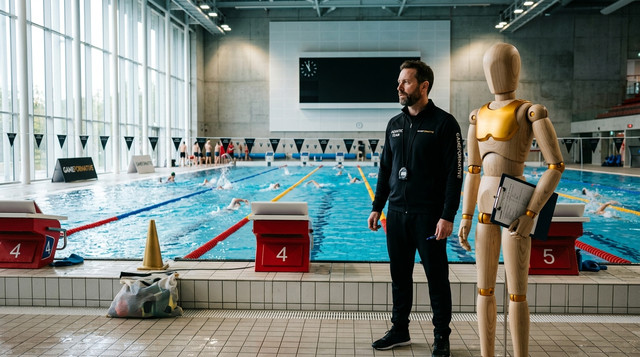
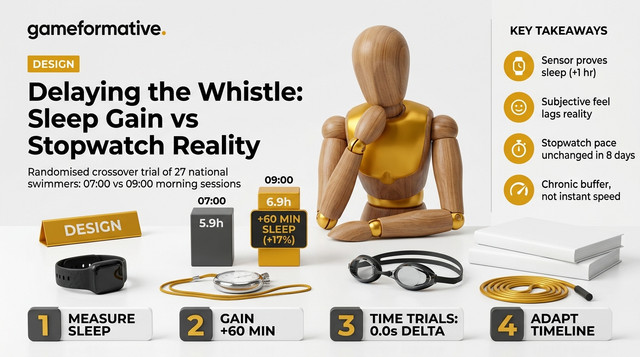
The researchers tracked 27 national-level swimmers across two separate eight-day training camps in Germany. In one camp, morning water sessions started at 07:00. In the other camp, the same athletes started at 09:00.
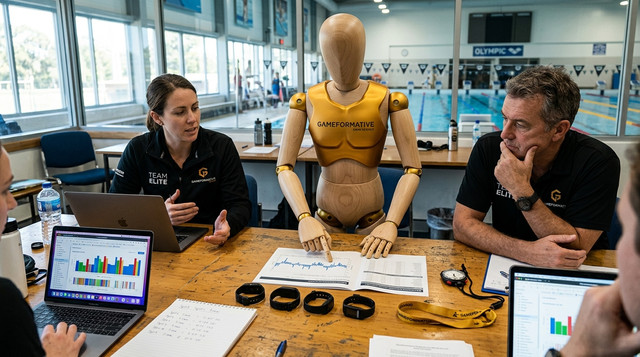
Wrist actigraphy measured actual sleep duration. Swimmers recorded 5.9 hours of sleep per night during the early-schedule block, compared with 6.9 hours during the delayed-schedule block: a statistically clear increase of exactly one hour.
Perceived sleep quality did not change between camps. Subjective stress and recovery scores showed no statistically significant shift. Time trials over 100 metres and 800 metres showed no measurable difference between the two start times.
 Design
What you can do with this
For head coaches, performance directors, and programme leads deciding when to schedule morning sessions, the takeaway must begin with timeline discipline.
Do not expect an acute eight-day schedule shift to transform competitive race times. Neural pacing, mitochondrial density, and stroke biomechanics do not reset in a single week just because bed rest lengthened.
How to start structuring adjustments across the season:
- Target chronic sleep debt across multi-month school terms rather than expecting sudden camp breakthroughs.
- Pair delayed morning starts with strict evening sleep hygiene so the wake-up shift does not simply encourage later screen time.
- Treat circadian alignment as an injury-prevention and cognitive buffer rather than an instant stopwatch booster.
 Design
What we would keep
Keep the empirical measurement standard. The researchers avoided subjective sleep logs and attached validated wrist actigraphs to every swimmer. That is how we know the athletes truly slept an extra hour rather than lying awake.
Keep the crossover design. Testing the exact same 27 athletes in both conditions eliminated individual variance in stroke efficiency and biological maturation.
Keep the honesty around short-term limits. The authors stated plainly that eight days is likely too short a period for physiological recovery to convert into race-pace gains.
What we would question
Question anyone claiming this study proves early mornings are harmless. Twenty-seven adolescent athletes over eight days is not powered to detect small, tenth-of-a-second margins that decide podiums.
Question treating sleep as an isolated variable independent of the academic calendar. A training camp environment controls nutrition and nap access in ways normal high school life never replicates.
A 2026 Frontiers in Physiology meta-analysis on daytime napping showed that a thirty-minute afternoon nap produced meaningful endurance gains across team ball sports. Sleep timing interacts with daytime rest opportunities.
How the field is arguing it
Traditional swimming programmes argue early morning pool time is unavoidable due to commercial lane availability and school commitments. Sport scientists counter that chronic sleep restriction in adolescents impairs motor learning, immune defence, and bone turnover.
The debate is shifting from whether adolescents need eight hours of sleep to how programmes construct recovery ecosystems. A 2026 network meta-analysis in Frontiers in Sports and Active Living found that fancy recovery gadgets rarely outperform passive rest and sound sleep.
When budgets get split between expensive pneumatic compression boots and schedule flexibility, plain sleep remains the stronger physiological foundation.
Closing note
Moving the morning whistle to 9 a.m. gives adolescent swimmers sixty minutes of vital sleep. It will not drop two seconds off a 100-metre butterfly by Friday, but it keeps young athletes healthy enough to reach the starting blocks next season.
Research record
Receipts for this article: sources, image provenance, and material we opened but did not rely on.
Mentioned entities
Products, brands, services and organisations named in this piece. Listed for clarity: this is not a sales offer. Try claims with a pinch of salt and compare other solutions.
- Sports Medicine – Open · organisation
- Frontiers in Physiology · organisation
- Frontiers in Sports and Active Living · organisation
Sources used
- Delaying Early Morning Training Time in Swimmers: Effects on Sleep, Recovery and Performance · Sports Medicine – Open · Randomised crossover trial of 27 national swimmers comparing 07:00 vs 09:00 morning sessions on sleep actigraphy and 100m/800m performance
- The effect of daytime napping on the athletic performance of team ball sports athletes · Frontiers in Physiology · Systematic review and meta-analysis of 12 RCTs showing endurance benefits from scheduled daytime rest
Image credits
- Headline: 09:00 morning session on competition lanes. GameFormative editorial desk. Licence: Original GameFormative editorial photography (free to use with this article; © GameFormative 2026).
- Inline: actigraphy telemetry review in high-performance aquatic lab. GameFormative editorial desk. Licence: Original GameFormative editorial photography (free to use with this article; © GameFormative 2026).
- Inline: poolside data review with coach and athlete. GameFormative editorial desk. Licence: Original GameFormative editorial photography (free to use with this article; © GameFormative 2026).
- Infographic: Delaying the Whistle, Sleep Gain vs Stopwatch Reality. GameFormative editorial desk. Licence: Original GameFormative editorial illustration (free to use with this article; © GameFormative 2026).
Sources investigated but not used
- Unavailable: not relied upon · Written vs. verbal sleep hygiene strategies administration in track and field athletes · J Sports Med Phys Fitness
- Unavailable: not relied upon · Polarized vs pyramidal training intensity distribution in recreational runners · SAGE Open Medicine
- Reviewed but not used · Physical recovery modalities in competitive and elite endurance athletes: network meta-analysis · Frontiers in Sports and Active Living