Ozempic isn't banned in sport. WADA still wants to know who's using it.
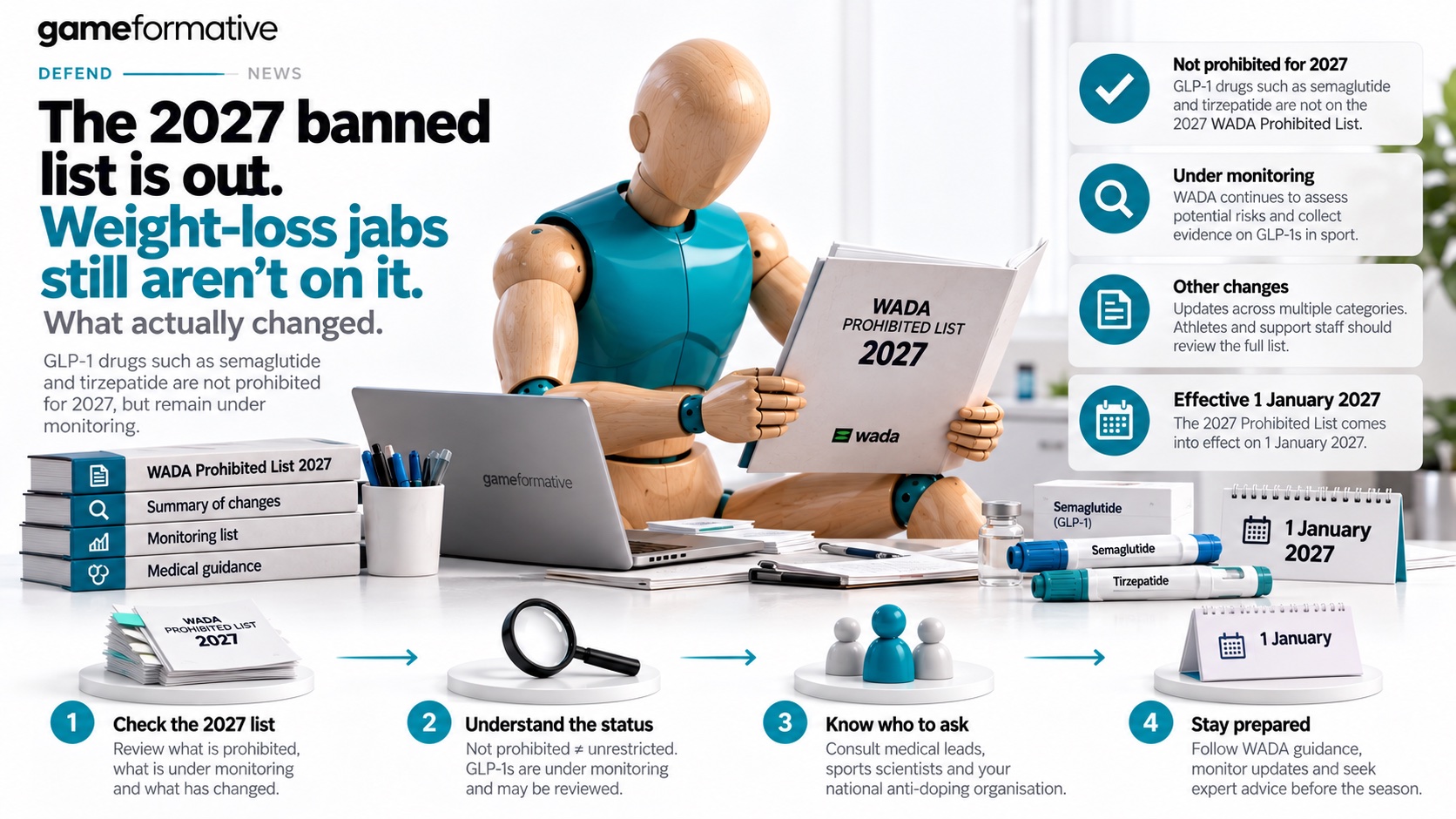
Semaglutide and tirzepatide are not prohibited under World Anti-Doping Agency rules for 2027, but WADA is still monitoring their use while it studies effects on athletes. Here's what monitored means, and why the distinction matters.
 Defend
Can an elite athlete take Ozempic without failing a test?
Can an elite athlete take Ozempic without failing an anti-doping test?
Under the 2027 World Anti-Doping Agency (WADA) Prohibited List, the short answer is no: semaglutide is not a prohibited substance. Neither is tirzepatide. Those are the active ingredients in brand-name GLP-1 (glucagon-like peptide-1) receptor agonists such as Ozempic and Wegovy (semaglutide) and Mounjaro and Zepbound (tirzepatide). After that, "GLP-1 drugs" is enough.
The 2027 list was published on 21 September 2026 and takes effect on 1 January 2027. WADA's own release says the status of these drugs remains unchanged for 2027 pending further data. They stay off the Prohibited List. They stay on the Monitoring Program. Sport-related research is already running, and a second study has been started.
So the interesting question is not whether the list banned Ozempic. It is why a drug that can remake body weight is being watched so carefully while still sitting outside the ban.
Why WADA is watching a drug it has not banned
WADA added semaglutide and tirzepatide to its Monitoring Program in 2024 to track prevalence and patterns of use in and out of competition. The Code's monitoring clause exists for substances that are not on the Prohibited List, but that WADA wants to watch for possible misuse.
The sporting worry is obvious once you leave the pharmacy aisle. A drug that can drive large drops in body mass sits next to sports where weight itself shapes competition: combat sports and other weight categories, endurance events, and any discipline where power-to-weight ratio matters. Lower mass can, in theory, change who fits a class, how a climber moves, or how an endurance athlete carries themselves over distance.
That is why regulators care about prevalence even before they have a finished performance case. Monitoring asks who is using these drugs, and in which sports, while the science of what that use does to competition is still incomplete.
 Defend
What "monitored" means, and what it does not
Keep three states distinct. They mean different things for an athlete.
Prohibited: an anti-doping rule applies. A positive test for a listed substance can lead to a sanction under the Code.
Monitored: not prohibited. WADA is collecting information about use. Appearance on the Monitoring Program is not, by itself, a ban, and it does not mean a future ban is scheduled.
Under study: scientific evidence is still being gathered. WADA has said one sport-related study is already running and a second has been initiated to look at effects on athletes.
What that means for 2027 is practical. Semaglutide and tirzepatide are not prohibited under WADA rules when the new list takes effect. Watch for the research results and the next annual review, not for a hidden soft ban inside the monitoring line.
 Defend
Weight loss is not automatically a sporting advantage
The hardest part of the story is that dramatic weight loss is not automatically performance enhancement.
Losing mass could help in some sporting contexts. Losing lean mass, including muscle, could hurt in others. A 2026 narrative review of incretin-based therapies reported that lean tissue can make up a large share of the weight lost on these drugs, and that clinical trials show no consistent improvement in human physical performance. That is physiology under debate. It is not a WADA verdict.
Olivier Rabin, WADA's senior director of science and medicine, pointed to the same uncertainty when explaining the 2027 decision: there is not enough evidence yet to conclude with confidence that the substances meet the criteria for inclusion on the List. A drug can change an athlete's body profoundly without anyone yet knowing whether that change consistently becomes a sporting advantage.
One short comparison athletes keep getting wrong
Do not confuse monitored with prohibited, and do not assume neighbouring products share a status.
Semaglutide and tirzepatide: monitored, not prohibited under the 2027 rules.
BPC-157: named on the Prohibited List under S0 as a non-approved substance. That is a different regulatory state.
Athletes shopping the same online peptide aisle can meet both kinds of product in one scroll. The anti-doping status does not travel with the shopping cart. One concise contrast is useful. A drug directory is not.
WADA looked at a ban and still lacked the evidence
The strongest reading of the 2027 decision is not "Ozempic got a free pass". It is that WADA's expert process considered GLP-1 drugs and still judged the evidence short of the listing bar.
To put a substance on the Prohibited List, WADA generally needs at least two of three criteria: potential to enhance performance, actual or potential health risk, and violation of the spirit of sport. Rabin's public explanation is that the agency cannot yet conclude those criteria are met with confidence. Studies already under way are meant to supply the missing sport-specific data.
Commercial noise pulls both ways: some pages treat monitoring as a loophole invitation, others invent a ban the list does not contain. The credible tension is simpler. A finished seasonal rule is sitting on unfinished performance evidence.
What would make WADA change its mind?
What would make WADA change its mind is clearer than a slogan about reading PDFs.
If sport-specific research and monitoring data show that GLP-1 drugs meet at least two of the three listing criteria with enough confidence, the status can move from monitored to prohibited at a later annual review. Until then, under the 2027 rules that take effect on 1 January, semaglutide and tirzepatide remain not prohibited, and remain watched.
The next fight is over the evidence, not over this year's headline.
Research record
Receipts for this article: sources, image provenance, and material we opened but did not rely on.
Mentioned entities
Sources used
- WADA publishes 2027 Prohibited List · WADA · Primary announcement: approval date, in-force date, GLP-1 stance, listing criteria
- Weight Loss Drugs: What athletes need to know about GLP-1s · USADA · National anti-doping organisation voice for athletes; not a second WADA PDF
- Incretin-Based Therapies in Sports (narrative review abstract) · Int J Mol Sci · Independent science perspective on lean-mass loss and missing performance proof; abstract opened
- Weight-loss drugs to remain on Wada monitoring list but not banned for 2027 · The Independent / PA · Rabin quote; monitoring since 2024; second study; ExCo revisit; two-of-three criteria
- 2027 Monitoring Program · WADA · Primary: semaglutide and tirzepatide monitored in and out of competition; Code Art. 4.5 monitoring purpose
Image credits
- Headline: WADA 2027 lab desk. GameFormative editorial desk (owner-provided). Licence: Original GameFormative editorial illustration (free to use with this article; © GameFormative 2026).
- Inline: GLP-1 production line. GameFormative editorial desk (owner-provided). Licence: Original GameFormative editorial illustration (free to use with this article; © GameFormative 2026).
- Inline: WADA list briefing. GameFormative editorial desk (owner-provided). Licence: Original GameFormative editorial illustration (free to use with this article; © GameFormative 2026).
- Infographic: not prohibited, monitored, under study. GameFormative editorial desk (owner-provided). Licence: Original GameFormative editorial illustration (free to use with this article; © GameFormative 2026).
Sources investigated but not used
- Reviewed but not used · 2027 Summary of Major Modifications and Explanatory Notes · WADA
- Reviewed but not used: duplicate evidence · WADA publishes 2027 Prohibited List (secondary) · Sport Resolutions