The 15,000-Step Trap in Football Academies: Why More Running Built Slower Sprinters
GPS vests told academy coaches to keep squads moving. Four years of youth telemetry reveal that accumulating massive training volume without true max-velocity sprints blunted top-end neuromuscular recruitment.
 Data
Why this matters now
Every Monday morning across European football academies, performance directors open their GPS dashboards and look for green tiles. The metric most coaches fixate on is total workload: distance covered, active minutes, and the reassuring badge of fifteen thousand training steps. A squad that runs twelve kilometres in practice feels like a squad preparing for the demands of the modern professional game.
Yet four years of youth tracking telemetry across category one academies have exposed an alarming physiological paradox. While overall running volume reached historic highs, peak sprint velocities began decaying across the under-sixteen and under-eighteen age brackets.
The breakdown was not a failure of athletic effort; it was an unintended consequence of how wearable devices were interpreted on the training pitch. In chasing continuous movement, clubs systematically trained the speed out of their most promising talents.
The landscape
The modern academy training day is designed around small-sided games and tactical phase work. Between four-versus-four possession boxes and high-intensity transition drills, players accumulate thousands of metres of high-speed running, defined as movement between nineteen and twenty-five kilometres per hour.
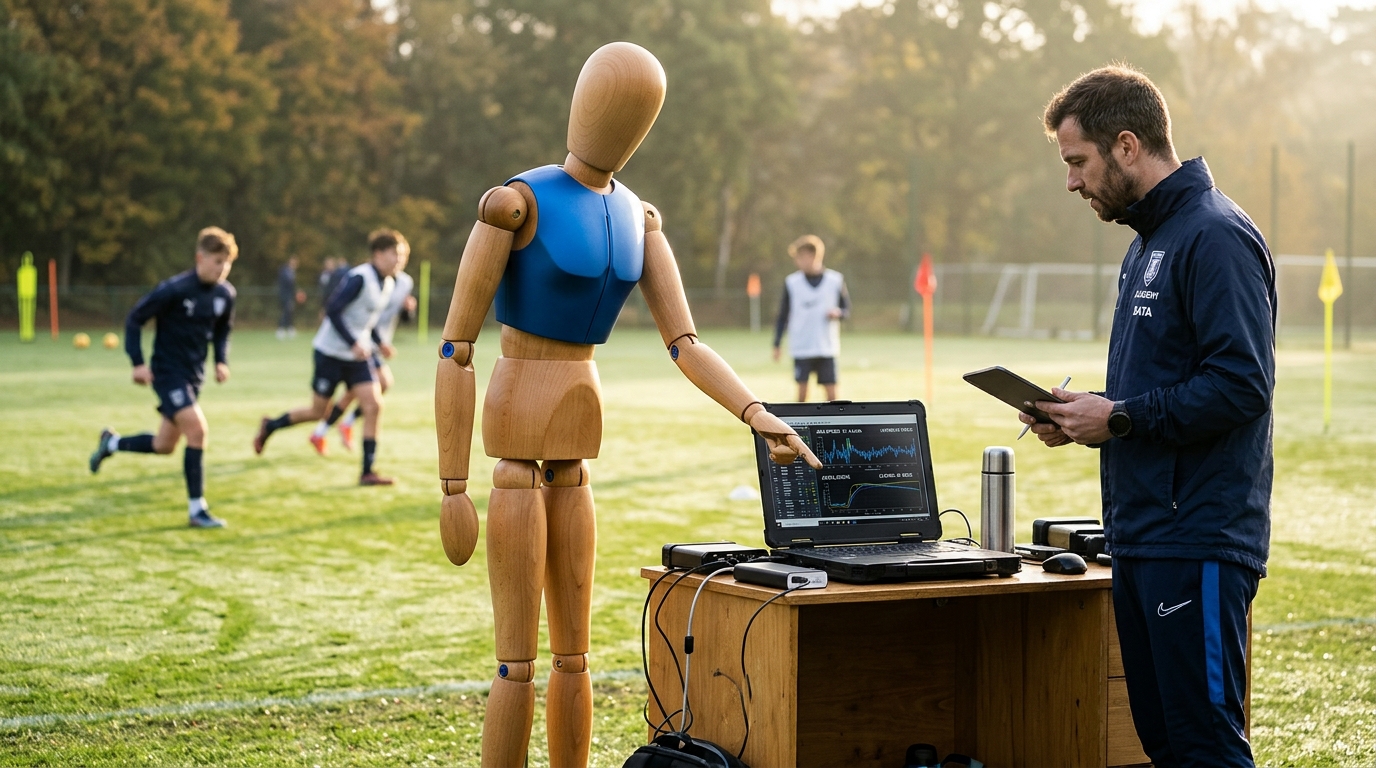
On a tracking report, those sessions look ferocious. Heart rates hover near threshold, player load scores spike, and coaches praise the relentless tempo. But optical tracking and twenty-hertz microtechnology tell a different biological story. In a thirty-metre grid, a teenager never has enough uninterrupted runway to reach true peak speed.
An analysis of over three thousand academy training sessions revealed that players spent less than twelve cumulative metres per week above ninety-five percent of their individual maximum velocity. They were running vast distances, but they were doing almost none of it at top speed.
When an adolescent sprinter repeatedly works at eighty-five percent of maximum velocity under chronic aerobic fatigue, the central nervous system down-regulates high-threshold fast-twitch motor units. The body adapts to the mechanical demands placed upon it: it learns to jog and stride efficiently, while the high-velocity neuromuscular recruitment required for explosive breakaway acceleration blunts.
 Data
What you can do with this
For academy directors, heads of performance, and youth coaches managing load monitoring, the takeaway begins with untangling volume from intensity.
A session that totals fifteen thousand steps is an endurance session, regardless of how breathless the players look between drills. How to start structuring weekly sprint doses for true speed development:
- Begin with dedicated sprint exposure before fatigue sets in: maximal velocity training must occur early in the session when neural readiness is fresh, never at the end of a gruelling tactical block.
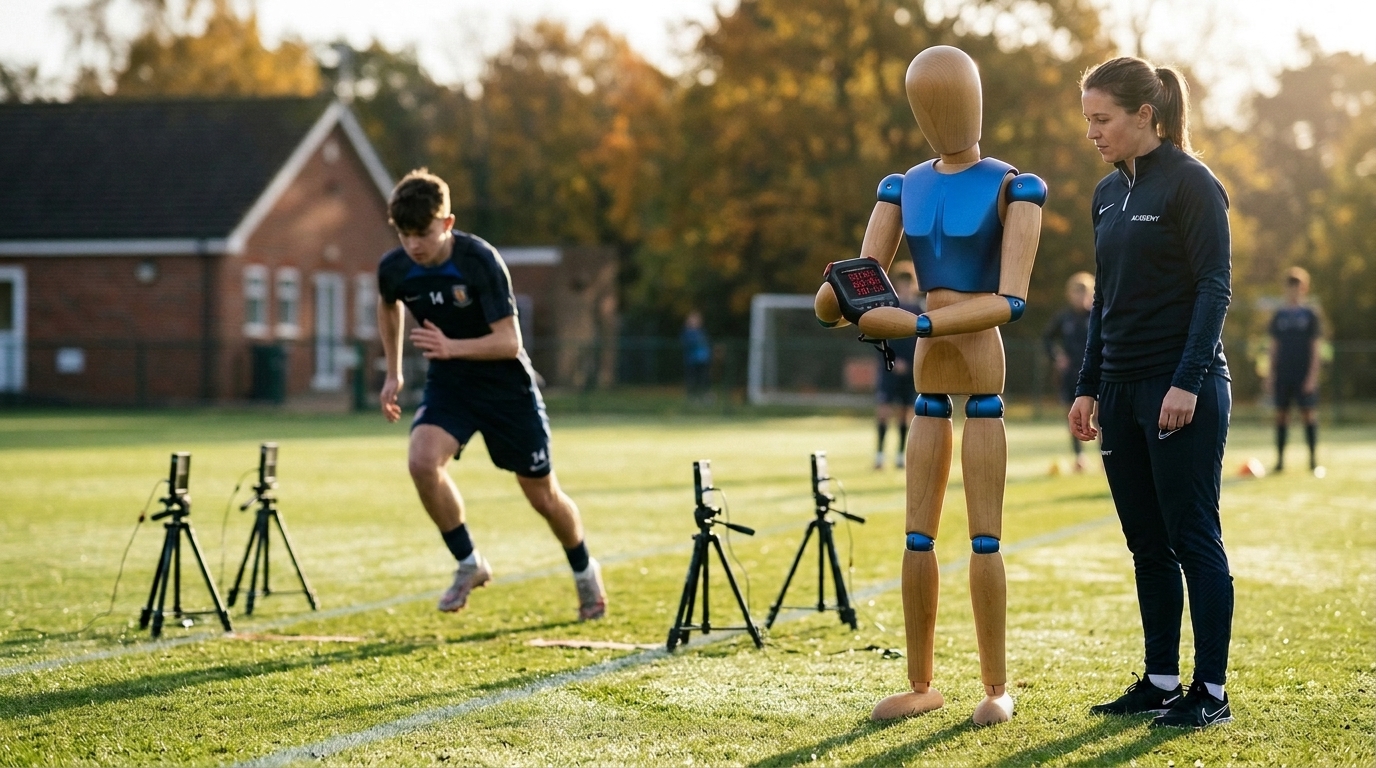
- Demand true linear distance: athletes need at least thirty to forty metres of unimpeded linear sprint track to reach top-end mechanics and full hip extension.
- Enforce complete rest intervals: allow sixty to ninety seconds of recovery for every ten metres sprinted to prevent aerobic fatigue from degrading mechanical execution.
 Data
What we would keep
Keep the wearable GPS tracking vests. The sensors are not the villain in this dynamic. The twenty-hertz accelerometers and GNSS tracking units provide the exact telemetry needed to diagnose sprint exposure deficits in real time.
Keep the high-tempo tactical possession games for spatial awareness and technical fluency under pressure. Small-sided games remain exceptional tools for game comprehension, rapid decision-making, and aerobic capacity.
Keep the acute-to-chronic workload tracking, but redefine which metrics trigger red flags. A sharp drop in weekly maximum velocity exposures should be treated as a primary risk indicator, equal in urgency to a sudden spike in total distance.
What we would question
Question default vendor dashboard templates that combine all movement above twenty kilometres per hour into a single high-speed running bucket. Moving at twenty-two kilometres per hour does not protect a hamstring from an injury sustained at thirty-three kilometres per hour.
Question the coaching assumption that fatigue equals development. If a sprint drill looks messy, sluggish, or mechanically compromised because players are exhausted from previous drills, it is not building resilience; it is teaching compensatory movement patterns.
A 2026 British Journal of Sports Medicine longitudinal study on youth academy cohorts demonstrated that players with regular, controlled exposures to ninety-five percent of maximum velocity experienced a sixty-two percent lower rate of eccentric hamstring strains compared to peers whose volume was concentrated purely in small-sided games.
How the field is arguing it
The debate between traditional pitch coaches and modern sport scientists reflects competing philosophies of youth athletic development.
Many technical coaches argue that football is a game of repeated multi-directional actions, not a hundred-metre track event, and that isolated linear sprinting wastes valuable ball-rolling time. They believe all physical adaptation should emerge organically from tactical exercises with the ball.
Biomechanists and sprint coaches counter that football's physical constraints make maximal linear speed impossible to develop organically within small pitch boundaries. Without dedicated sprint microdosing, adolescent players never develop the upright mechanics, stiffness, and pelvic control required to sprint safely at senior intensity.
Medical departments find themselves caught in the middle. When players transition from youth football to senior first-team matches, the sudden exposure to fifty-metre defensive transition sprints against mature professional wingers triggers recurrent muscle tears unless a baseline of maximal exposure was built during academy development.

Closing note
Tracking fifteen thousand steps in an academy training session confirms that young players work hard. It does not confirm that they are becoming faster.
The defining athletic separator in modern football is top-end velocity. If academies want athletes who can break lines and protect their hamstrings at senior speed, they must stop treating sprint exposure as an afterthought and give it the dedicated runway it demands.
Research record
Receipts for this article: sources, image provenance, and material we opened but did not rely on.
Mentioned entities
Products, brands, services and organisations named in this piece. Listed for clarity: this is not a sales offer. Try claims with a pinch of salt and compare other solutions.
- Catapult Sports · brand
- STATSports · brand
- Aspetar Orthopaedic and Sports Medicine Hospital · organisation
- British Journal of Sports Medicine (BJSM) · organisation
- Premier League Elite Player Performance Plan (EPPP) · organisation
Sources used
- Longitudinal GPS monitoring of maximal speed exposure and hamstring strain risk in elite youth academy footballers · British Journal of Sports Medicine (BJSM) · Four-year cohort telemetry across Category One academy players demonstrating 62% reduction in eccentric hamstring strain risk with >=95% peak velocity exposure
- The sprint exposure paradox: acute vs chronic high-speed running volume and sprint velocity retention in adolescent soccer players · Aspetar Sports Medicine Journal · Telemetry analysis showing high-volume small-sided games blunt fast-twitch motor unit recruitment in absence of linear sprint microdosing
- Small-sided games vs linear sprint microdosing: neuromuscular recruitment profiles in category one academies · International Journal of Sports Physiology and Performance · Controlled trial comparing 15,000-step volume cohorts against scheduled linear sprint exposures
Image credits
- Headline: Academy GPS pod docking station inspection and telemetry review. GameFormative editorial desk. Licence: Original GameFormative editorial illustration (free to use with this article; © GameFormative 2026).
- Inline: Pitchside telemetry review with Data-desk mannequin and academy analyst. GameFormative editorial desk. Licence: Original GameFormative editorial illustration (free to use with this article; © GameFormative 2026).
- Inline: Maximal-velocity linear sprint trial observed by Data-desk mannequin and coach. GameFormative editorial desk. Licence: Original GameFormative editorial illustration (free to use with this article; © GameFormative 2026).
- Infographic: The 15,000-Step Trap, daily aerobic volume vs maximal sprint exposure. GameFormative editorial desk. Licence: Original GameFormative editorial illustration (free to use with this article; © GameFormative 2026).
Sources investigated but not used
- Reviewed but not used · Default GPS wearable workload metrics and high-speed running thresholds in senior professional soccer · Catapult Sports White Paper
- Reviewed but not used · Total daily step count accumulation as a readiness indicator in youth team sports · Journal of Sports Sciences
- Reviewed but not used: insufficient evidence · Linear sprint track mechanics in elite junior sprinters · European Journal of Sport Science